

Production
The cashew tree (Anacardium occidentale L.) is a pitchy-barked tropical evergreen native to northeastern Brazil. Of the eight recognized Anacardium species, only the cashew is economically significant, due to its nutritious kernel and edible hypocarp (apple). With smooth, leathery leaves measuring 10-20 cm long by 5-10 cm wide, the tree can grow to a height of more than 15 meters. The cashew tree is an andromonoecious plant, with hermaphrodite and male flowers growing on the same panicle.
In the 16th century, Portuguese traders brought the cashew tree to India and Mozambique; from there, it spread further across tropical regions of Asia and Africa. Fast-growing, deep-rooted and well adapted to sandy soils, the cashew tree was initially planted in coastal areas to control soil erosion. Nowadays, however, it is primarily used for cashew nut production.[1]
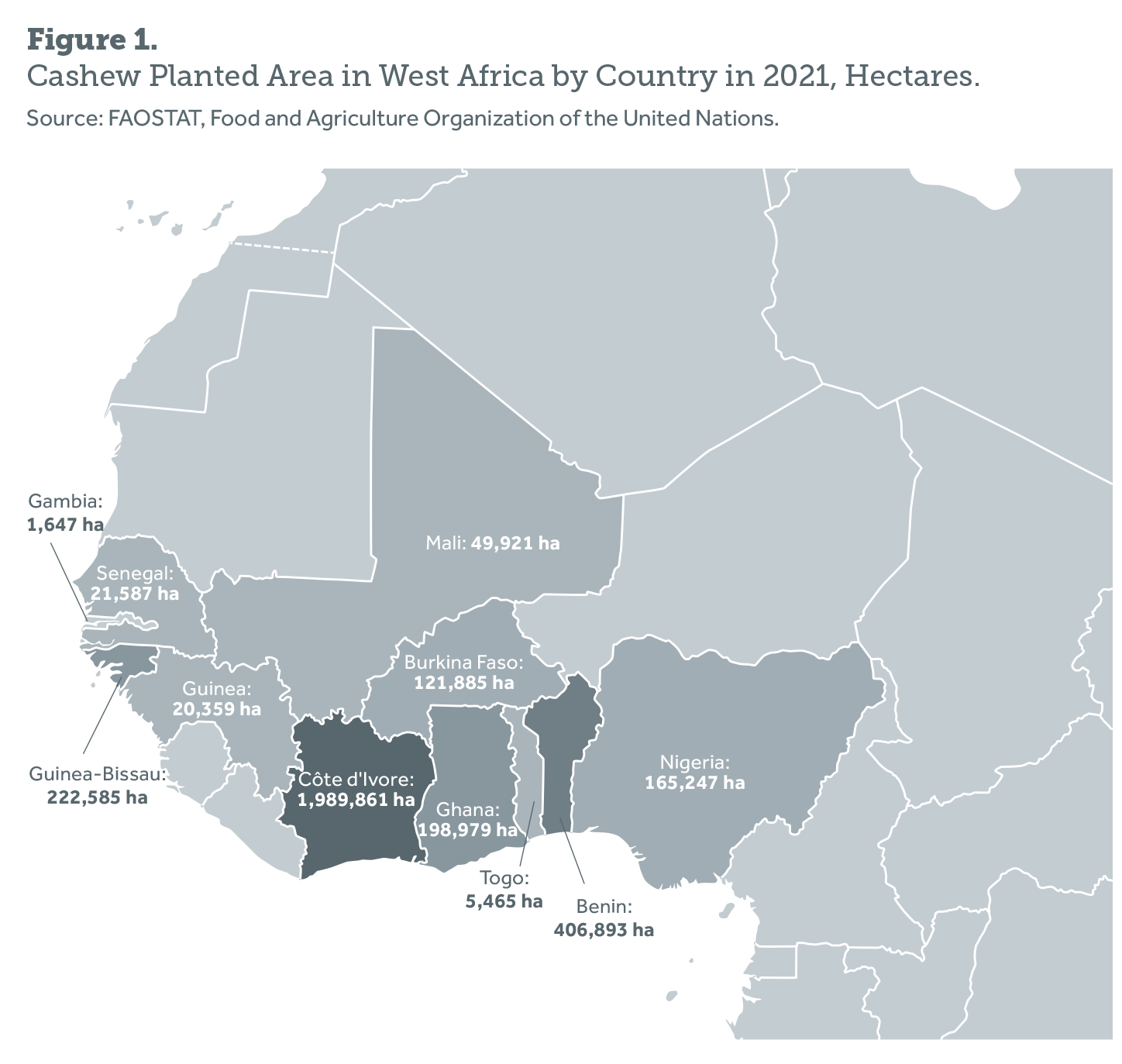
Cashew is grown in several countries across West Africa. By planted area, the leading country is Côte d’Ivoire, followed by Benin, Guinea-Bissau, Ghana, Nigeria and Burkina Faso (Figure 1).
Figure 1. Cashew Planted Area in West Africa by Country in 2021, Hectares.
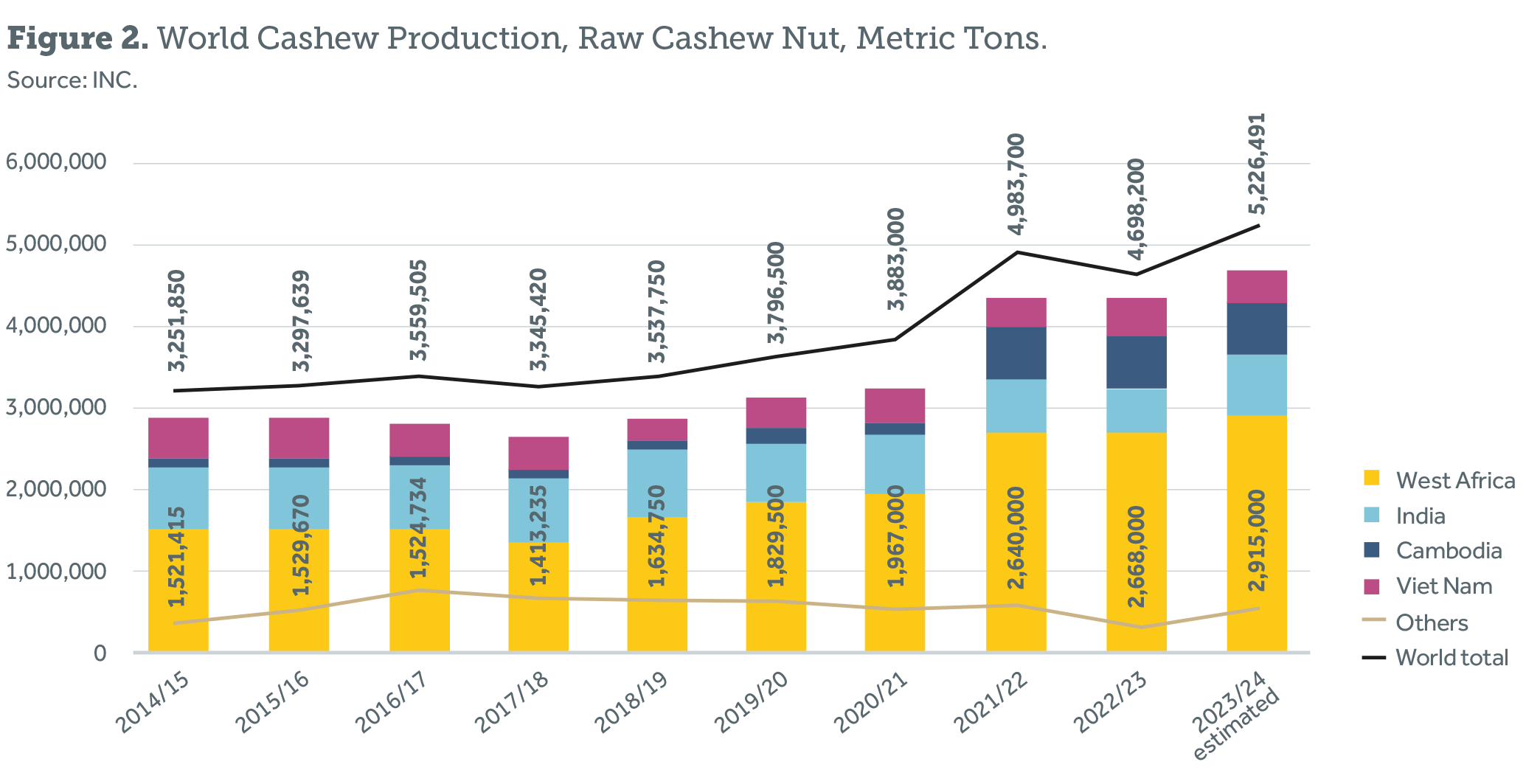
West Africa is the world’s leading cashew-growing region, accounting for 54% of global raw cashew nut (RCN) production in the 2022/23 season and 56% in 2023/24, according to current estimates (Figure 2).
Figure 2. World Cashew Production, Raw Cashew Nut, Metric Tons.
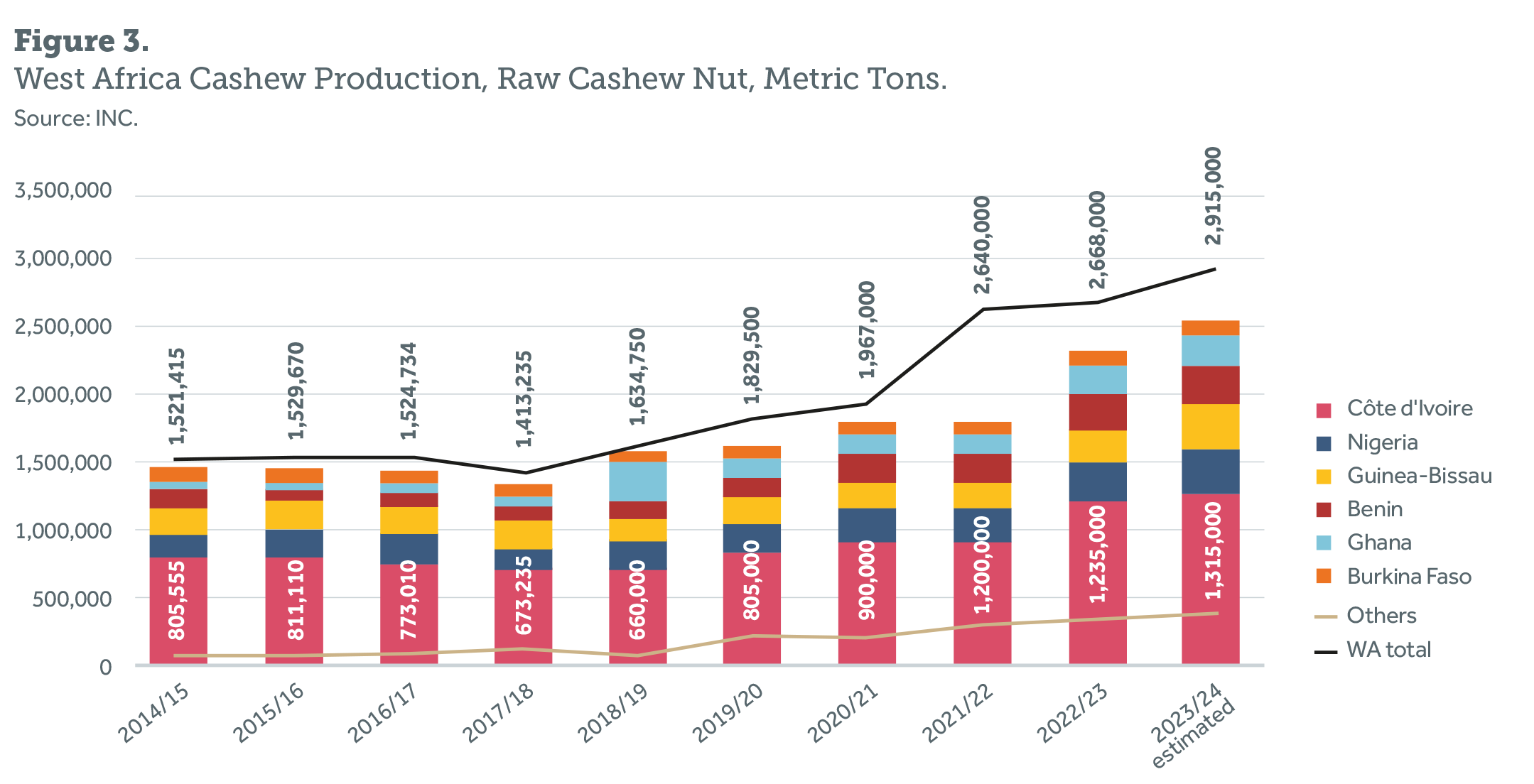
Of the estimated 2.9 million metric tons of RCN produced by West Africa in 2023/24, the region’s top producer was Côte d’Ivoire with a crop of 1.3 M MT, followed by Nigeria and Guinea-Bissau with 300,000 MT each, Benin with 250,000 MT, Ghana with 235,000 MT and Burkina Faso with 150,000 MT (Figure 3). West Africa’s RCN output has risen by more than 92% since the 2014/15 season, mainly as a result of growth in land cultivation rather than an increase in yield.[1]
Figure 3. West Africa Cashew Production, Raw Cashew Nut, Metric Tons.
Processing
Traditionally, only a small percentage of West African cashews are processed in their country of origin. Most cashew nuts are exported in-shell to India and Viet Nam, where further value-adding activities are carried out.[1] In recent years, however, West Africa has seen a number of private-sector and government-backed investments in local cashew-processing facilities. One such facility is Benin’s Glo-Djigbé Industrial Zone (GDIZ), a “integrated industrial park that is specifically designed to support the growth and development of the country’s cashew industry.”[2] In Côte d’Ivoire, meanwhile, processing facilities have been set up in Bondoukou, Korhogo, Bouaké, Yamoussoukro and Abidjan.[3] In June 2023, the government of Côte d’Ivoire and two private investment groups signed a memorandum of understanding that provides for the construction of a cashew processing plant capable of handling 200,000 MT per year.[4] If this trend continues, West Africa will be able to increase its processing rate and keep more value inside the cashew-growing countries.
Trade
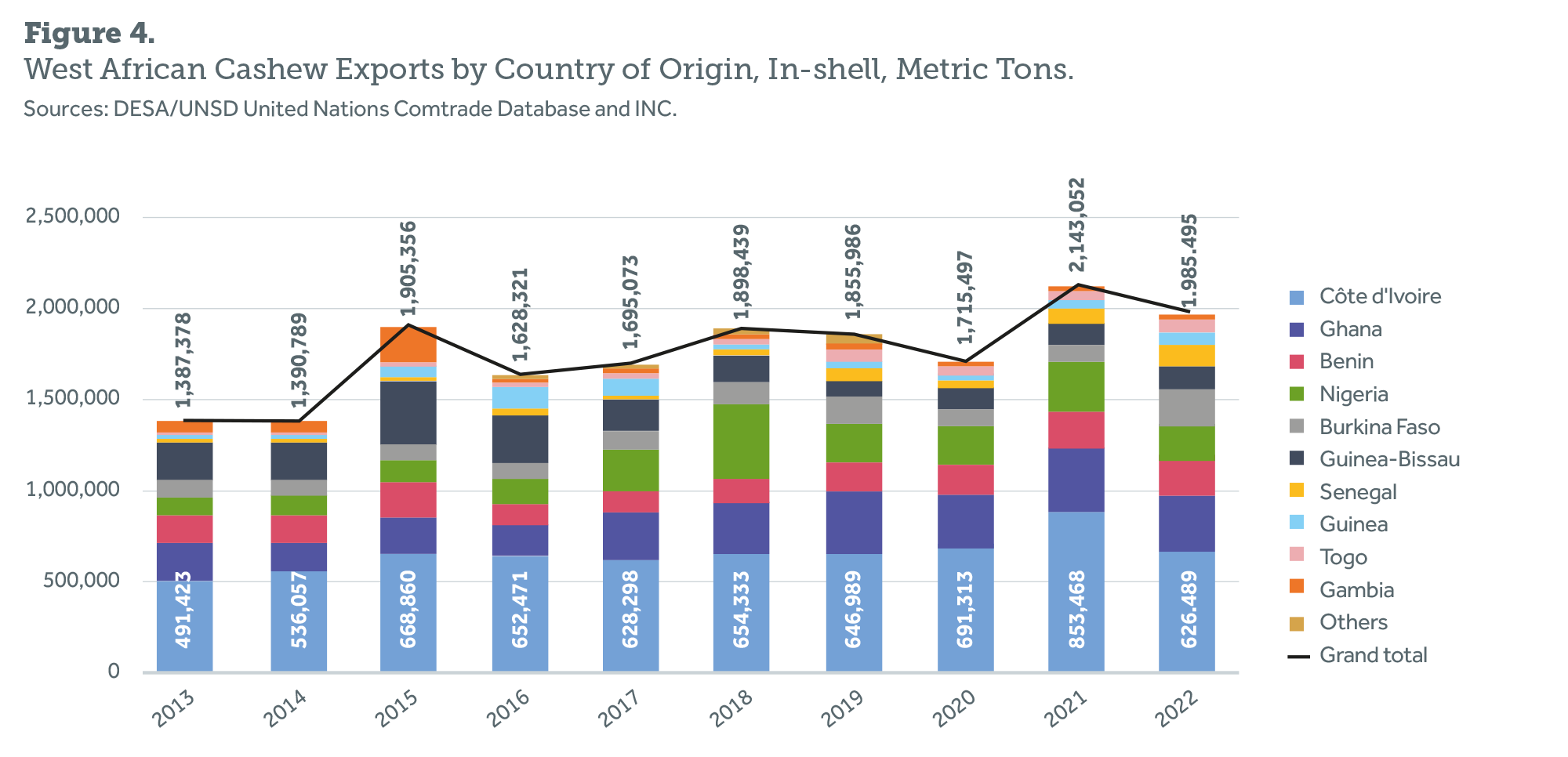
Cashew is West Africa’s second most important export crop, after cocoa, in terms of value.[5] Inshell exports, which totaled nearly 2 M MT in 2022, account for the vast majority of the region’s international trade in cashews. Over the past decade, Côte d’Ivoire has been West Africa’s leading cashew exporter, accounting for an average of 36% of the region’s share over the last five years (Figure 4).
Figure 4. West African Cashew Exports by Country of Origin, In-shell, Metric Tons.
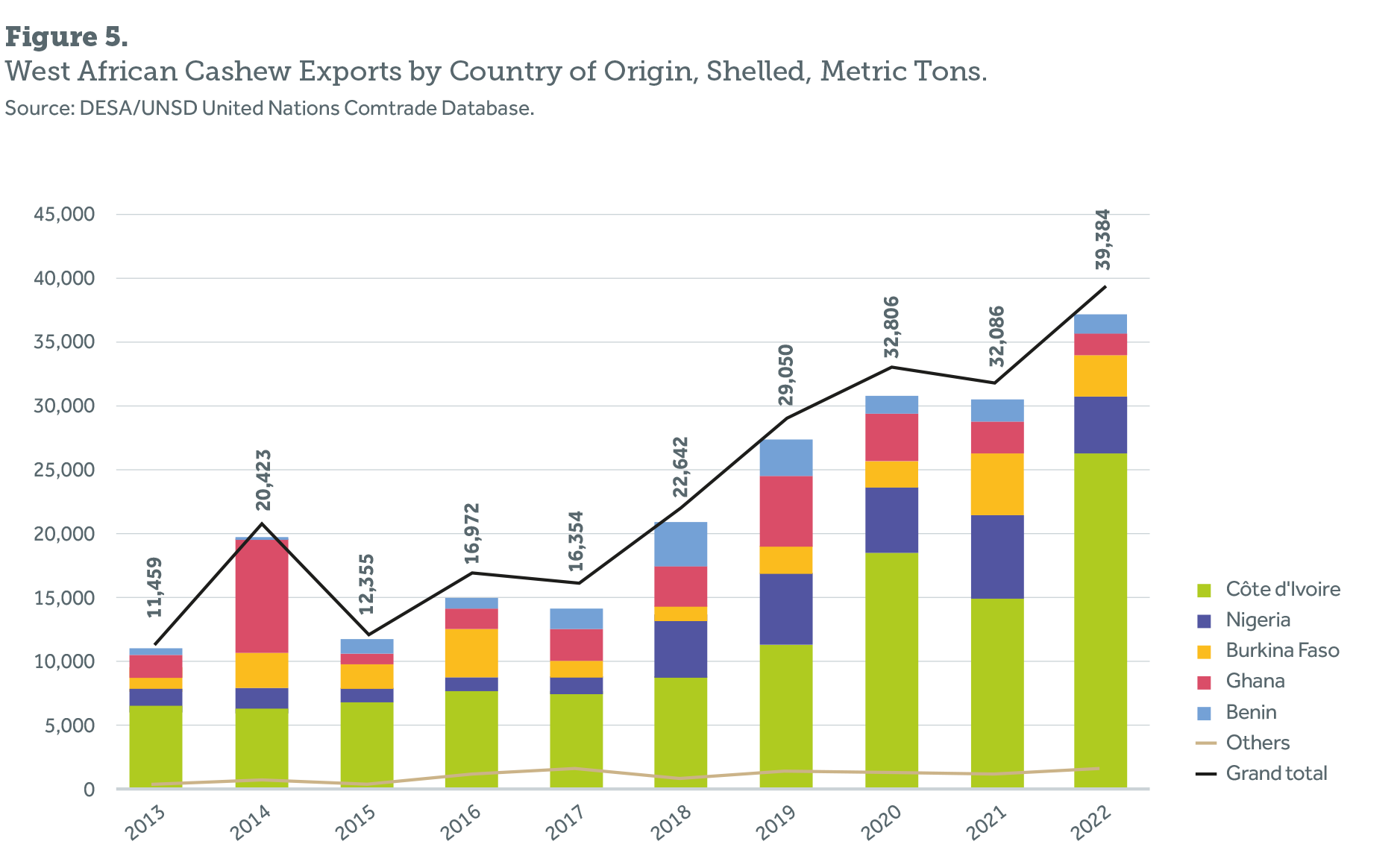
Shelled cashews account for a small percentage of West Africa’s total cashew exports. Over the past five years, shelled exports have averaged 31,194 MT per year, compared with 1.9 M MT for in-shell cashews. In absolute terms, however, shelled cashew exports have risen sharply over the past several years as new local processing facilities have come online. Whereas the region as a whole exported just 11,459 MT of shelled cashews in 2013, this figure had reached 39,384 MT by 2022 —a more than threefold increase over the course of a decade (Figure 5).
Figure 5. West African Cashew Exports by Country of Origin, Shelled, Metric Tons.
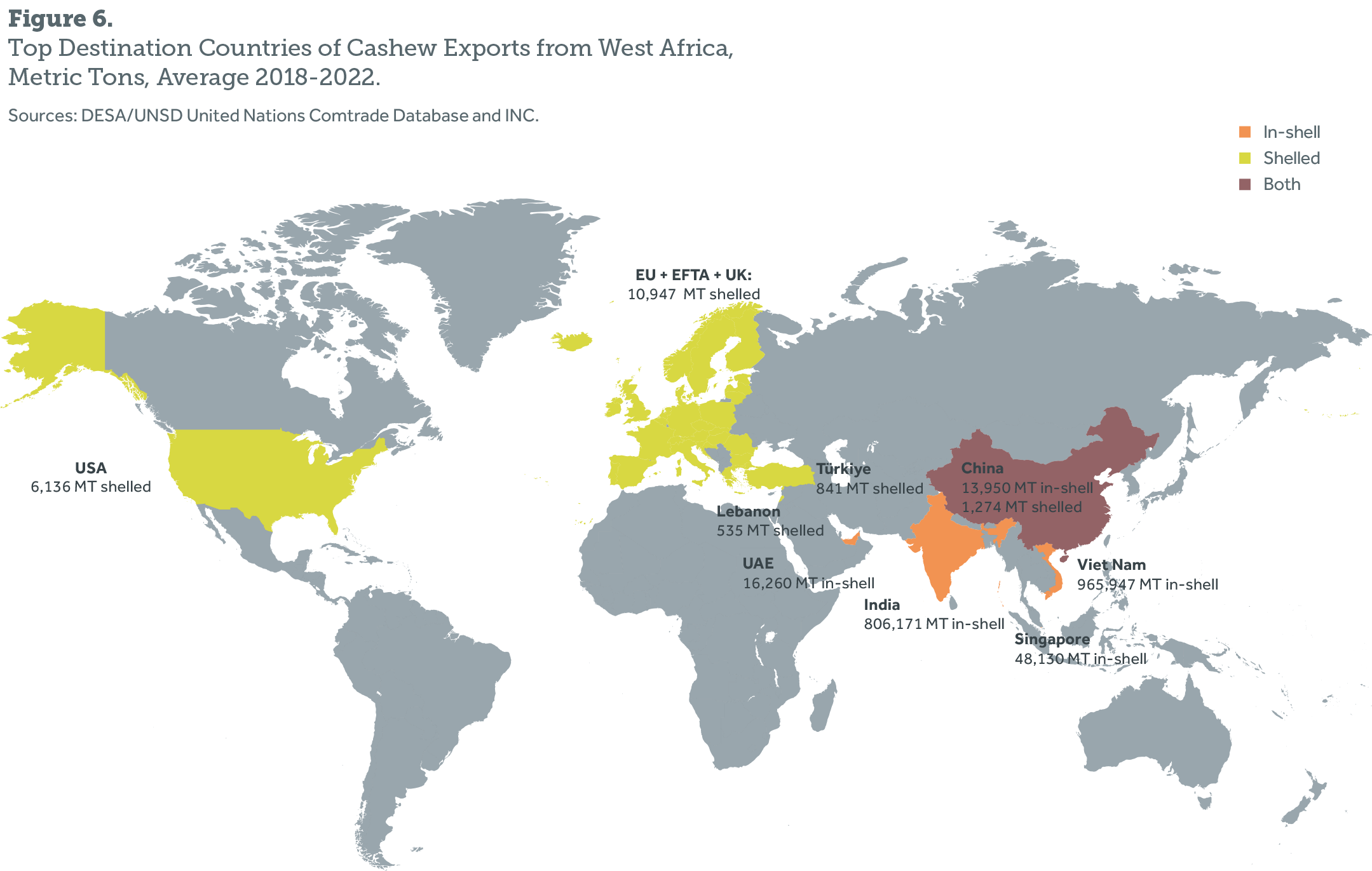
By far, the top destinations for West African cashews are Viet Nam and India, which imported an average of 966,000 MT and 806,000 MT of in-shell cashews over the past five years, respectively. Europe is the leading importer of shelled West African cashews, averaging 11,000 MT over the past five years, followed by the US market with 6,000 MT (Figure 6).
Figure 6. Top Destination Countries of Cashew Exports from West Africa, Metric Tons, Average 2018-2022.
[1] United Nations Conference on Trade and Development (2021). Commodities at a Glance: Special Issue on Cashew Nuts. https://unctad.org/publication/commodities-glance-special-issue-cashew-nuts
[2] Babatunde, O.P., et al. (2023). Cashew Production and Breeding in 5 West African Countries. Journal of Scientific Research and Reports, 29(5), 28–39. https://doi.org/10.9734/ jsrr/2023/v29i51745. 3. World Bank (2019). Cashing in on Cashews in Côte d’Ivoire: Using the Future Export Revenue of Cashew Nuts to Facilitate IBRD Enclave Lending – Case Study. https://documents.worldbank.org/en/publication/documents-reports/documentdetail/590321546962406589/pdf
[3] World Bank (2019). Cashing in on Cashews in Côte d’Ivoire: Using the Future Export Revenue of Cashew Nuts to Facilitate IBRD Enclave Lending – Case Study. https://documents.worldbank.org/en/publication/documents-reports/documentdetail/590321546962406589/pdf
[4] Arise Integrated Industrial Platforms, https://www.ariseiip.com/blog-cashew-industry-in-benin/
[5] Marot, C. (2021, June 28). “With domestic value addition, Côte d’Ivoire is finally cashing in on its cashews.” Equal Times. https://www.equaltimes.org/with-domestic-value-addition-cote
[6] Comité National de Pilotage des Partenariats Public-Privé, Côte d’Ivoire (2023, June 5). “Communiqué de presse – Le Gouvernement de Côte d’Ivoire signe trois protocoles d’accord pour un montant total de 450 millions de dollars USD.” https://ppp.gouv.ci/2023/06/05/le-gouvernement-de-cote-divoire-signe-trois-protocoles-daccord-pour-un-montant-total-de-450-millions-de-dollars-usd/
[7] Babatunde, O.P., et al. (2023). Cashew Production and Breeding in 5 West African Countries. Journal of Scientific Research and Reports, 29(5), 28–39. https://doi.org/10.9734/jsrr/2023/v29i51745