

Production
Chile’s tradition of growing and processing fruit dates back to the colonial period, when these plants were brought over by the Spanish. Starting in the 16th century, European fruit trees were successfully adapted to Chilean soils and climates, making it possible to introduce the production process.[1] Moving into the 21st century, Chile’s “fruit boom” of the 1970s was led by grapevines, apples and stone fruit trees.[2] Nowadays, Chile is a major producer and the top exporter of dried and fresh plums worldwide.
The main species grown in Chile are the Japanese plum (Prunus salicina), which is typically sold fresh, and the European plum (Prunus domestica L.), which is mainly used in the production of prunes (dehydrated plums). European plums are characterized by an elongated shape, a dark skin color and a pit that is easily separable from the pulp, making them the most appropriate type of plum for industrial processing. Within this group, D’Agen is the variety most commonly used for drying due to its high sugar content.
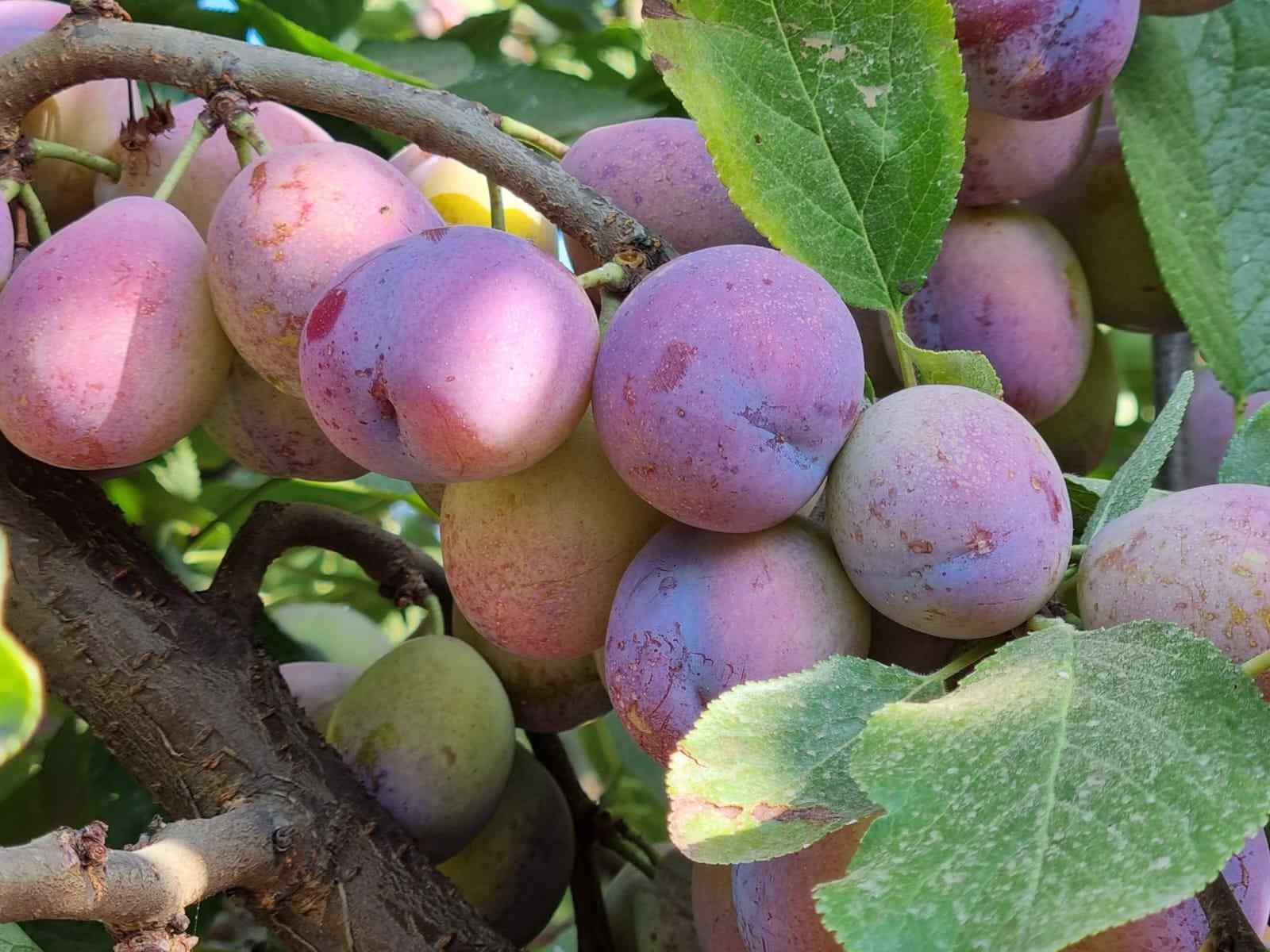
Photo courtesy of Chileprunes
The fresh fruit is harvested in February and March and the processing season runs from April to December, due to the low perishability of the product. The ratio between fresh and dehydrated product ranges from 3 to 4 kilograms of fresh fruit per kilogram of dehydrated plum, depending on whether the pit is included or not.
In Chile, plums have traditionally been dehydrated by leaving the fruit under the sun in drying fields. This practice yields good results due to the climatic conditions of the production regions. However, a significant amount of product is dried in dehydration tunnels —a faster and more controlled drying method that results in a more homogenous quality. Once the product is dehydrated, it is calibrated, selected and washed to start the “tenderization” process, a heat treatment that restores a certain level of humidity, making the product softer for consumption.[3],[4],[5]
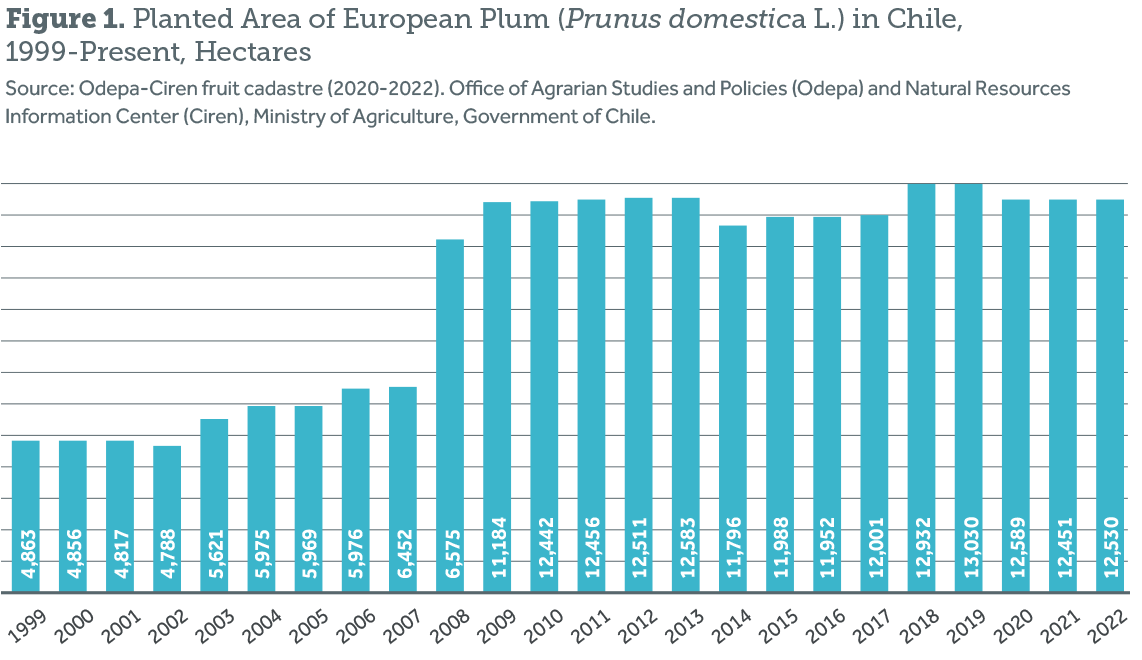
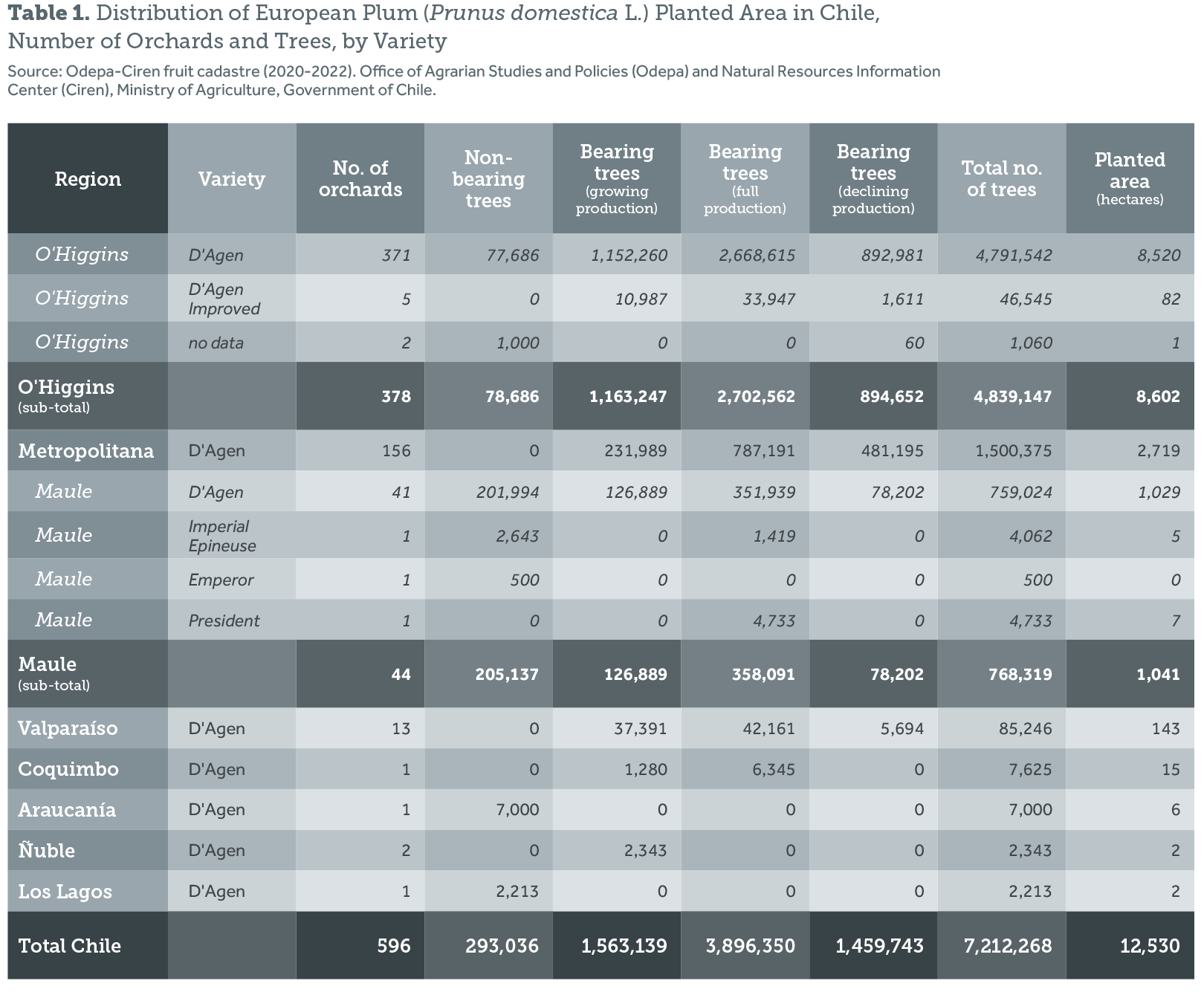
According to the Odepa-Ciren fruit cadastre, the area planted with European plums in Chile is 2.6 times larger today than at the beginning of the 21st century. The planted hectarage increased by 70% in 2009 compared with 2008 and seems to have stabilized ever since (Figure 1). The total planted area is currently 12,530 hectares, of which 69% is located in the O’Higgins region, followed by the Metropolitan region with a 22% share and Maule with 8%. Of the total planted area, 96% consists of bearing trees and 99% of the trees are of the D’Agen variety (Table 1 and Figure 2). Of a total of 593 orchards, 87% have a size ranging from 1 to 50 hectares and all of them are irrigated, with drip irrigation being the predominant system.
 As reported by Chileprunes, the Chilean association of processors and exporters of prunes, the total production of plums averages around 100,000 metric tons (MT) annually. Of this amount, about two thirds are used in the production of dehydrated plums, while around 20,000 MT go to the fresh Chinese market, following in the footsteps of the flourishing Chilean cherry industry in that market. The remaining 15,000 MT are used in concentrated juices and pulps, oils and other products. The juice and pulp demand is mainly concentrated in the United States, Canada, the United Kingdom and Australia.
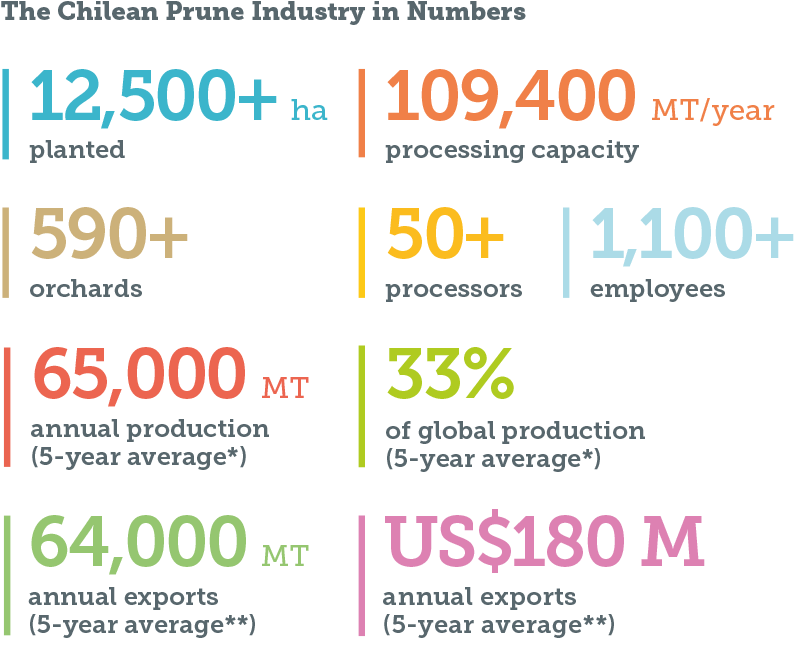
Chile is one of the world’s top prune producers. Chilean production over the last decade ranged from 57,000 to 70,000 MT. Output during the 2020/21 season was unusually low due to an extreme drought that affected the producing regions. Production in 2022/23 is estimated at 65,000 MT (Figure 3). “The O’Higgins region, which is where the largest European plum plantations are located, did not suffer weather problems, so it has had an impeccable harvest,” commented Pedro Pablo Díaz, President of Chileprunes. “Its fruits look good, with good sizes, volume and Brix content.”

As per the latest Odepa-Ciren reports, with a capacity of 109,456 MT/year, the processing industry employs 1,177 people in 51 companies. O’Higgins accounts for 51% of the processing capacity, followed by the Metropolitan region with 47% and Maule with the remaining 2%.
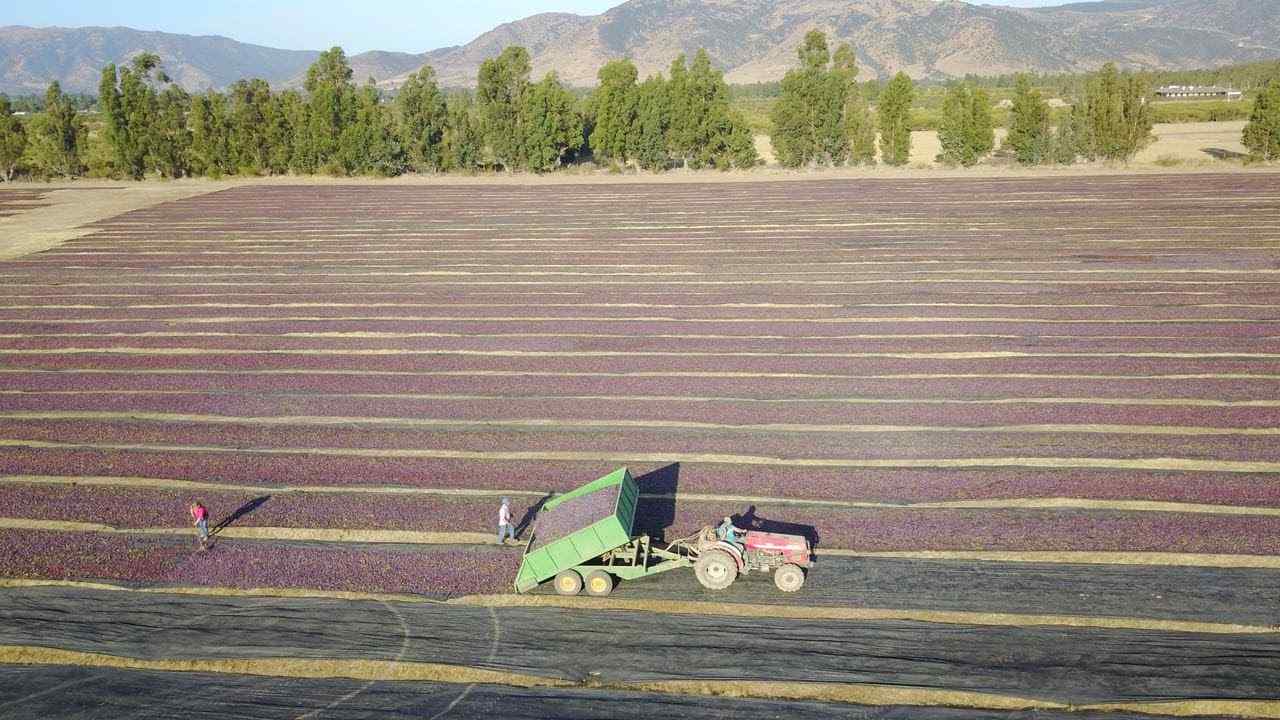
Prune drying field. Photo courtesy of Chileprunes.
Trade
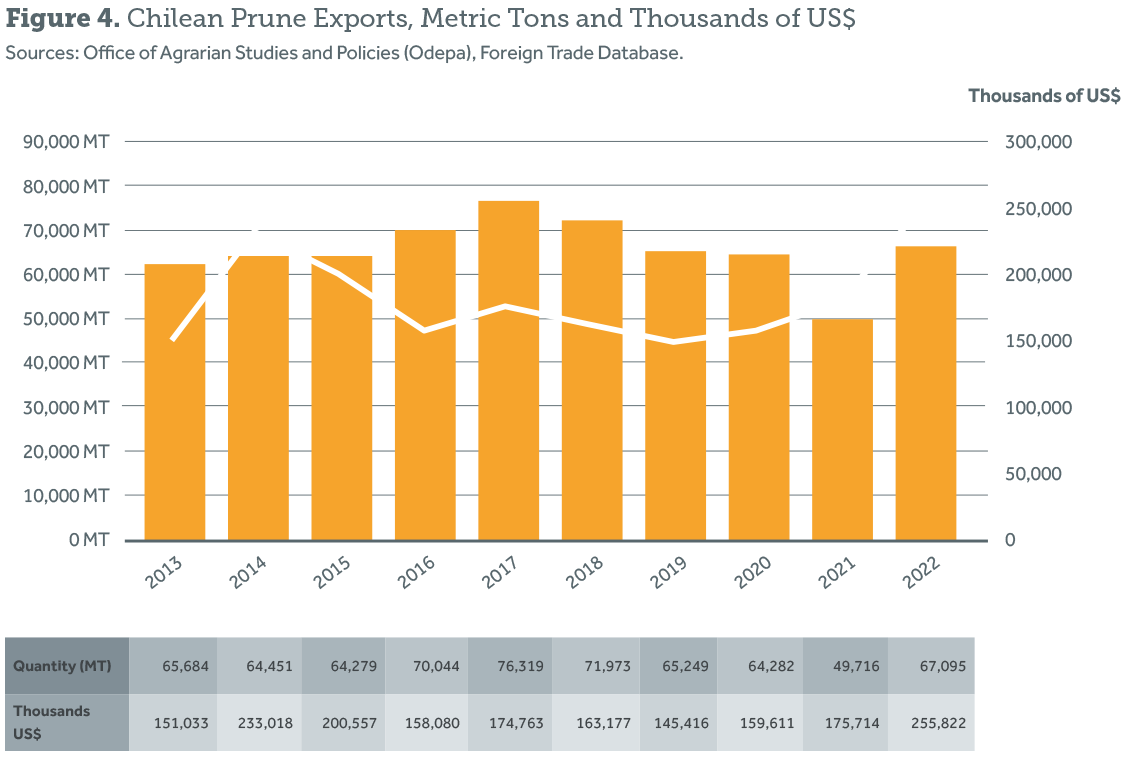
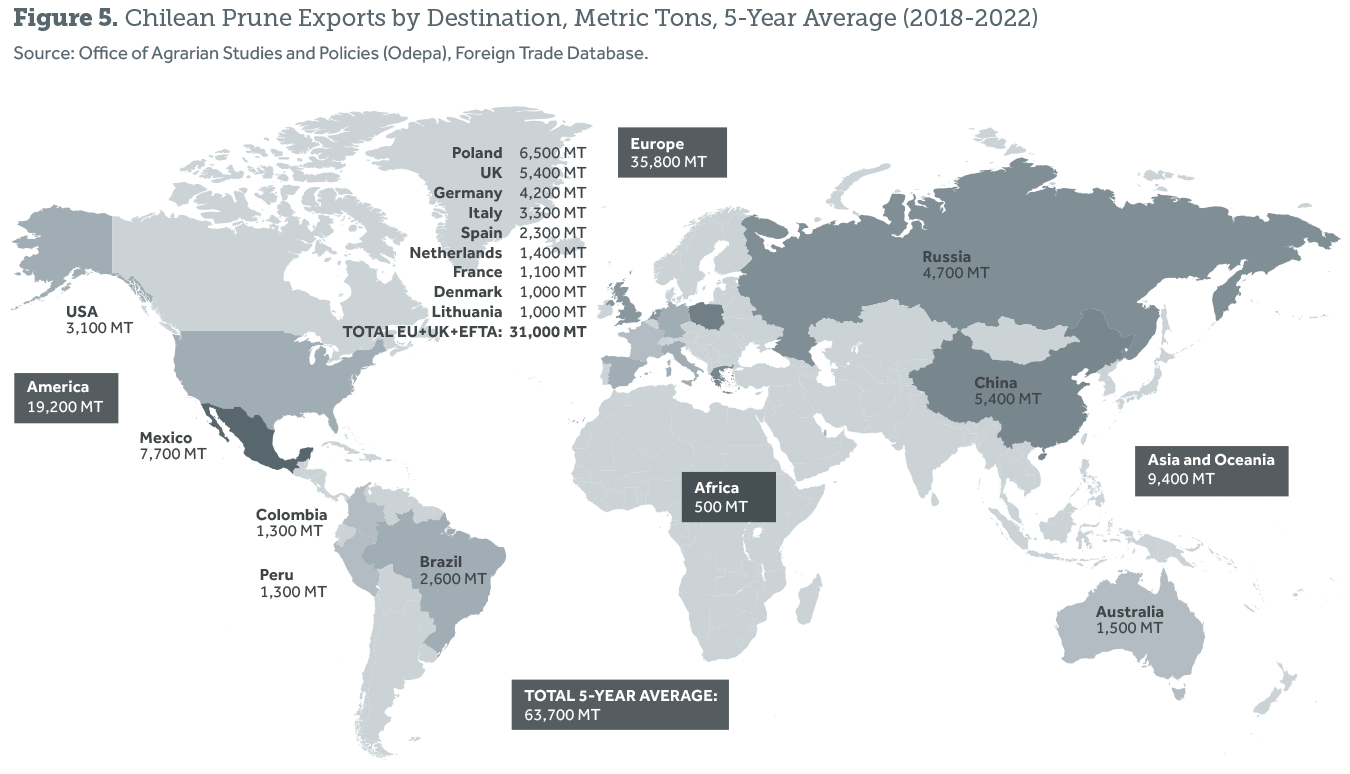
Accounting for a 33% share of trade globally,[6] Chile is the world’s top prune exporting country. Annual international shipments amount, on average, to 63,700 MT and US$180 million (5-year average, 2018-2022).[7] As highlighted by Chileprunes, the quality of Chilean prunes —with organoleptic characteristics providing a distinctive acidity and sweetness equilibrium, a very good size and flavor, and a highly versatile supply— makes Chile the main global exporter, delivering product to more than 80 countries.
Over the last decade, exports have remained fairly stable, ranging from 62,000 MT to 76,000 MT; with the exception of shipments in 2021, which were unusually low as a result of the extreme drought that significantly impacted the 2020/21 season inventory. In turn, the value of total exports ranged from a minimum of US$145 million to a high of $US256 million in 2022 (Figure 4).
Considering the last five years of international shipments, the top markets were the European Union (plus the United Kingdom and the countries of the European Free Trade Association), which accounted for an average share of 49%, followed by Mexico (12%), China (9%), Russia (7%) and the United States (5%) (Figure 5).
The Chinese market for Chilean prunes saw spectacular growth in 2022. Last year, with a total of 11,800 MT imported, China ranked first as an importer for the first time, with volumes nine times higher than ten years ago and six times higher than in 2021. Similarly, the US and Australian markets reached 5,100 MT and 1,600 MT, up by 120% and 46% over 2021, respectively.
“Chile is experiencing turbulent times,” commented Pedro Pablo Díaz, President of Chileprunes. “In 2022, annual inflation reached 12.8%, the highest rate since 1991, and all signs suggest that it will tend to normalize in 2023. The exchange rate has fluctuated, causing uncertainty for the exporters. As for activities more typical of the industry, agrochemical prices have skyrocketed, and labor, though available, is scarce.”
“Another challenge for Chileprunes is to further strengthen the Food Export Council, an institution of which we are members,” added Díaz. “We believe in the fundamental role of this association in promoting Chile’s food exports —the country’s second most important sector after mining.” Founded in 2005, the members of Chileprunes today account for 70% of the country’s prune exports.
References
[1] Frutos secos en Chile y Cuyo. Nogales, almendros y castaños (2009). Aranda, M, Yuri, J.A., Castro San Carlos, A., Solar, M., Soto, N., Quinteros, K., Gaete, J., Rivas, J., Chávez; C. Lacoste, P.A. (coord.). HIB: revista de historia iberoamericana, Vol. 2, N.º. 2, pp. 38-51.
[2] Los aportes del INIA en el desarrollo y auge del nogal chilena. Gamalier, L.S. (2018). Available at: https://biblioteca.inia.cl/handle/123456789/5440.
[3] Ciruelas frescas y deshidratadas. Farías-Pérez, C. (2004). Oficina de Estudios y Políticas Agrarias, Ministerio de Agricultura, Gobierno de Chile. Available at: https://www.odepa.gob.cl/publicaciones/articulos/ciruelas-frescas-y-deshidratadas-2.
[4] Ciruelas secas: proyecciones de sobrestock y precios a la baja. Tapia-Cruz B. and González-Zagal, C. (2012). Oficina de Estudios y Políticas Agrarias, Ministerio de Agricultura, Gobierno de Chile. Available at: https://www.odepa.gob.cl/wp-content/uploads/2012/07/6647_ArtCiruelasSecas072012.pdf.
[5] Guía de Producción del Ciruelo Europeo (2020). Publicación CIREN Nº 222. Centro de Información de Recursos Naturales, Ministerio de Agricultura, Gobierno de Chile.
[6] INC Database, 5-year average, 2017-2021.
[7] Office of Agrarian Studies and Policies (Odepa), Foreign Trade Database.