
‘Antioxidant’ berries, anthocyanins, resveratrol and rosmarinic acid oxidize hydrogen sulfide to polysulfides and thiosulfate: A novel mechanism underlying their biological actions
Nutraceutical polyphenol catechins in green tea oxidize H2S to polysulfides (PS) in buffer and in cells thereby conveying their cytoprotective effects. Here we measure H2S oxidation in buffer and HEK293 cells by over-the-counter nutraceuticals, blueberry, bilberry and cranberry, and by polyphenols, cyanadin (Cya), quercetin (Que), rosmarinic acid (RA) and resveratrol (Res). H2S and PS were measured with specific fluorophores, AzMc and SSP4 respectively, and thiosulfate (TS) production was measured in buffer using silver nanoparticles (AgNPs). All compounds increased polysulfide production from H2S in buffer and increased polysufides in cells. Decreasing oxygen from 100% to 21% and 0% progressively decreased PS production by Que and RA in buffer and Que decreased PS production in cells incubated in 5% O2 compared to 21% O2. Que, RA and Res, but not Cya, increased TS production from H2S in 21% O2 but not in 0% O2. Superoxide dismutase did not affect PS production from H2S by Que or TS production from H2S by Que, RA or Res, whereas catalase inhibited TS production by all three polyphenols. Conversely, these polyphenols only slightly reduce a mixed polysulfide (K2Sn) or thiosulfate to H2S in 0% O2. Collectively, our results suggest that polyphenols are autoxidized to a semiquinone radical and that this, in turn, oxidizes H2S to a thiyl radical from which polysulfides and thiosulfate derived. They also suggest that this is catalyzed by a semiquinone radical and it is independent of either superoxide or hydrogen peroxide concomitantly produced during polyphenol autoxidation. The polysulfides produced in these reactions are potent antioxidants and also initiate a variety of downstream cytoprotective effector mechanisms. It is also possible that H2S can be regenerated from the thiosulfate produced in these reactions by other cellular reductants and reused in subsequent reactions.

Dietary Strategies by Foods with Antioxidant Effect on Nutritional Management of Dyslipidemias: A Systematic Review
Nutrition plays a fundamental role in the prevention and treatment of dyslipidemias and its oxidative-related complications. Currently, there is evidence about the beneficial effects of isolated antioxidants or foods enriched or added with antioxidant compounds. However, the application of the natural foods is more integrated than the analysis of a single nutrient. Our aim is compiling scientific literature regarding the nutritional strategies by foods with antioxidant effect in blood lipids, enzymatic and non-enzymatic antioxidants, and oxidative and inflammatory markers of subjects with dyslipidemia. We searched in MEDLINE/PubMed, Scopus, and Web of Science. From a total of 263 studies screened, 16 were included. Dietary strategies included walnuts, olive oil, raw almonds, G. paraguayase, white sesame, mate tea, Brazil nut flour, red wine, granulated Brazil nuts, grapes, wolfberry fruit, fermented beverage, coffee, orange, and blackberry juices showed significant differences in blood lipids, antioxidant activity, antioxidant enzymes, and oxidative and inflammatory markers. This systematic review compiling scientific studies about dietary strategies using foods with antioxidant effect to improve the antioxidant status in dyslipidemias.
Therapeutic Potential of Resveratrol in COVID-19-Associated Hemostatic Disorders
Coagulation disorders, endotheliopathy and inflammation are the most common hallmarks in SARS-CoV-2 infection, largely determining COVID-19's outcome and severity. Dysfunctions of endothelial cells and platelets are tightly linked in contributing to the systemic inflammatory response that appears to be both a cause and a consequence of COVID-19-associated coagulation disorders and thrombotic events. Indeed, elevated levels of circulating inflammatory cytokines are often associated with abnormal coagulation parameters in COVID-19 patients. Although treatments with low molecular weight heparin (LMWH) have shown beneficial effects in decreasing patient mortality with severe COVID-19, additional therapeutic strategies are urgently needed. Utilizing the anti-inflammatory and anti-thrombotic properties of natural compounds may provide alternative therapeutic approaches to prevent or reduce the risk factors associated with pre-existing conditions and comorbidities that can worsen COVID-19 patients' outcomes. In this regard, resveratrol, a natural compound found in several plants and fruits such as grapes, blueberries and cranberries, may represent a promising coadjuvant for the prevention and treatment of COVID-19. By virtue of its anti-thrombotic and anti-inflammatory properties, resveratrol would be expected to lower COVID-19-associated mortality, which is well known to be increased by thrombosis and inflammation. This review analyzes and discusses resveratrol's ability to modulate vascular hemostasis at different levels targeting both primary hemostasis (interfering with platelet activation and aggregation) and secondary hemostasis (modulating factors involved in coagulation cascade).
Hazelnut Crop Progress Report
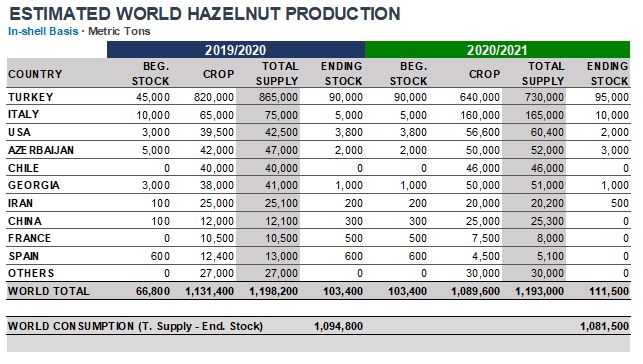
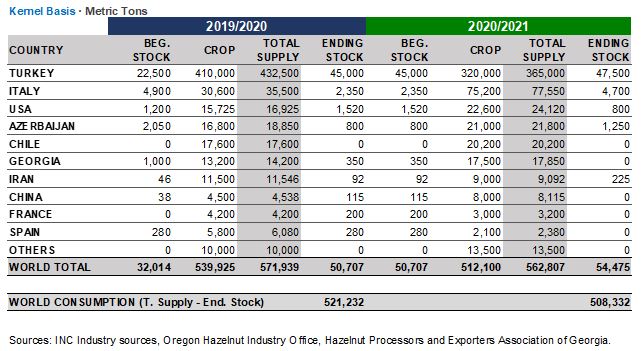
Turkey Hazelnut Crop Progress Report
Italy Hazelnut Crop Progress Report
USA Hazelnut Crop Progress Report
The pandemic continues to present production challenges, although the crop was still all processed in time as to not interrupt production. On a positive note, the “channel-switching” that has occurred across many products may very well provide an opening for new uses for Oregon’s ever-increasing supply of kernels. Traditional in-shell markets, particularly in Asia, were reduced this year as compared to the historical average. The trade challenges between the US and China continue to hamper volumes headed into this channel. Meanwhile, stable kernel demand warranted much of the crop to be shelled. Overall volumes shipped have been typical with other crops, however, with kernel making up a larger percentage than normal.
Walnut Crop Progress Report
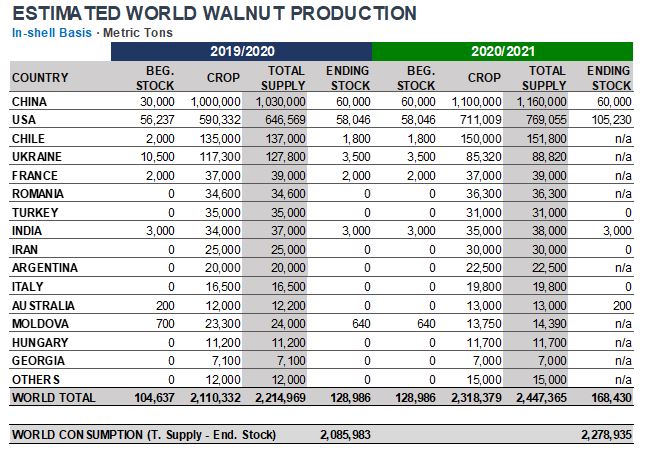
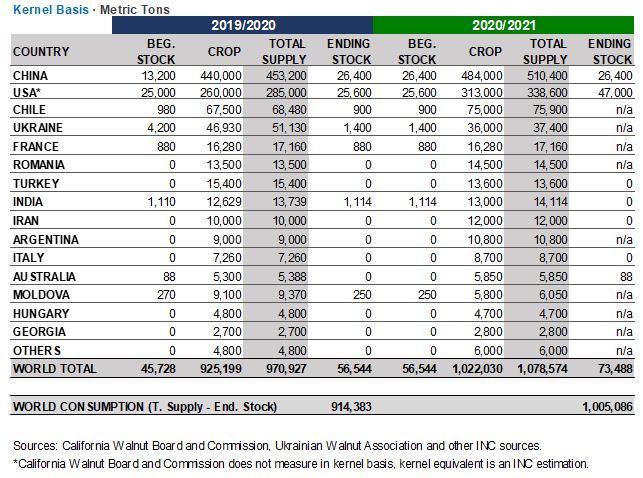
China Walnut Crop Progress Report
Overseas shipments are not as strong as last season due to a lack of containers for both ocean and land transport. The high freight rate coupled with unfavorable currency exchange has refrained exports from increasing. While anticipating robust local consumption, led by roasted nuts retail and the Chinese New Year’s demand, the industry will try to achieve stronger exports at lower pricing later on in the season.
USA Walnut Crop Progress Report
Overall, market demand remains strong driven by increased use at home. Shipments through December 31, 2020, for both in-shell and shelled, have been robust in the Middle East and Africa, showing combined gains of over 30%. With an April Ramadan, shipments are expected to remain strong. While Asian overall demand is increased, many European markets, due to the ongoing pandemic and varying restrictions, are slightly down as compared to the prior year.
In response to strong retail sales in the US and Canada, in-shell and shelled shipments have increased during the first four months of the crop season.
Chile Walnut Crop Progress Report
Walnut Crop Progress Report
China Walnut Crop Progress Report
Overseas shipments are not as strong as last season due to a lack of containers for both ocean and land transport. The high freight rate coupled with unfavorable currency exchange has refrained exports from increasing. While anticipating robust local consumption, led by roasted nuts retail and the Chinese New Year’s demand, the industry will try to achieve stronger exports at lower pricing later on in the season.
USA Walnut Crop Progress Report
Overall, market demand remains strong driven by increased use at home. Shipments through December 31, 2020, for both in-shell and shelled, have been robust in the Middle East and Africa, showing combined gains of over 30%. With an April Ramadan, shipments are expected to remain strong. While Asian overall demand is increased, many European markets, due to the ongoing pandemic and varying restrictions, are slightly down as compared to the prior year.
In response to strong retail sales in the US and Canada, in-shell and shelled shipments have increased during the first four months of the crop season.
Chile Walnut Crop Progress Report
Hazelnut Crop Progress Report
Turkey Hazelnut Crop Progress Report
Italy Hazelnut Crop Progress Report
USA Hazelnut Crop Progress Report
The pandemic continues to present production challenges, although the crop was still all processed in time as to not interrupt production. On a positive note, the “channel-switching” that has occurred across many products may very well provide an opening for new uses for Oregon’s ever-increasing supply of kernels. Traditional in-shell markets, particularly in Asia, were reduced this year as compared to the historical average. The trade challenges between the US and China continue to hamper volumes headed into this channel. Meanwhile, stable kernel demand warranted much of the crop to be shelled. Overall volumes shipped have been typical with other crops, however, with kernel making up a larger percentage than normal.
Almond Crop Progress Report
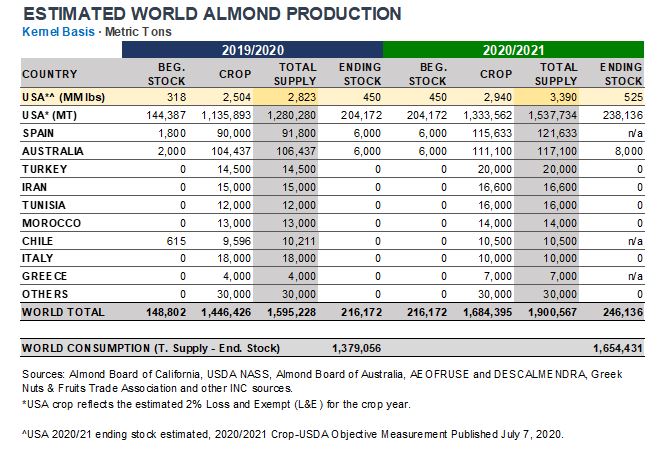
USA Almond Crop Progress Report
Total shipments August through December are up a staggering 22% from 2019/20 at 1.284 billion pounds (around 582,400 MT) which is commensurate with a total supply that is up 23% over the same period. Domestic shipments August through December are up 11.5% from last crop year to 332 million pounds (150,600 MT). Exports are up 26% over the same time period. All regional exports are up year-over-year except for the Middle East. Shipments to key markets India and China/Hong Kong are up 79% and 54% respectively when compared to the first 5 months of last crop year. Given robust commitments and adequate supply, shipments are expected to continue to break records in 2021 as we await bloom and the development of the FY 21/22 crop.
Australia Almond Crop Progress Report
The 2020 crop produced a record tonnage of 111,000 MT. The loss of bee hives in bush fires at the beginning of 2020, plus COVID-19 related travel restrictions within Australia, caused some concerns for the pollination season in August. Fortunately, beekeepers managed to replace hives and move enough to orchards in southern Australia for pollination to be completed successfully. As reported by the Almond Board of Australia, the growing conditions for the 2021 crop have been favorable. The size of the 2021 crop, to be harvested commencing in February, is forecast at 123,000 MT. The kernel size appears to be very good and this may increase the crop size above the forecast figure should harvest proceed well.
After a slow start to the marketing year for the 2020 crop, shipments picked up with monthly records set for September, October and November. Grower returns are being impacted by lower global almond prices and the stronger Australian dollar exchange rate against the US dollar. The Export Position Report shows 2020/21 shipments from March through November amounted to 66,522 MT (kernel weight equivalent). Asia Pacific was the main destination with 44,681 MT. Vietnam and India had year to date increments of 157% and 38% compared to the same period in 2019/20. Exports to Europe were 14,603 MT. Germany, the Netherlands (with a strong increment from the previous season) and Spain being the major European importers.
Spain Almond Crop Progress Report
As per AEOFRUSE, based on the Ministry of Industry, Trade and Tourism of Spain data overall shipments YTD –August through November, including re-exports from other origins, conventional and organic; natural and processed almonds– added up to 44,600 MT, similar to the same period in 2019/20. The European Union remains as the leading destination, accounting for 87% of the share. While Germany was the top importer within the EU, the highest increments compared to 2019/20 were presented by Portugal and the Netherlands (13% each), Italy (11%) and France (9%).
Taste and Food Safety are Prioritized over Sustainability for European Citizens When Purchasing Food
With the European Commission publishing the EU Farm to Fork Strategy earlier in 2020, the Eurobarometer was a specially commissioned survey to evaluate what factors are at play in EU citizens' minds when it comes to food. One of the key findings was that consumers in the EU do not factor in sustainability as much as taste, safety, and cost, however, the results are not entirely bad for sustainability. The survey also revealed that an overwhelming majority of EU citizens welcome additional information on food sustainability. It was found that 88 percent agree that information on sustainability should be required on food labels and 85 percent agree that there should be one logo to help you choose healthy and sustainable foods.
For the full report from the USDA, click here.