
Cashew nut shell liquids: Antimicrobial compounds in prevention and control of the oral biofilms.
Objective: The aim was to evaluate the antibacterial and antibiofilm activity of natural (n-CNSL) and technical (t-CNSL) cashew nut shell liquid against streptococci and enterococci related to dental caries and chronic apical periodontitis, respectively.
Material and methods: Minimum inhibitory concentrations (MIC) and minimal bactericidal concentration (MBC) were determined to assess the antimicrobial effect of both CNSLs (n-CSNL and t-CNSL) against S. oralis ATCC 10557, S. sobrinus ATCC 6715, S. parasanguinis ATCC 903, S. mutans UA 159 and E. faecalis ATCC 19433. The antibiofilm activity was evaluated by total biomass quantification, colony forming unit (CFU) counting and scanning electron microscopy (SEM). Furthermore, cytotoxic effect of the substances was evaluated on L929 and HaCat cell lines by MTS assay.
Results: The n-CNSL and t-CNSL showed inhibitory and bactericidal effect against all strains tested in this study, with MIC and MBC values ranging from 1.5 to 25 μg/mL. Overall, both CNSLs showed significant reduction in biomass quantification and enumeration of biofilm-entrapped cells for the strains analyzed, in biofilm formation and preformed biofilms (p < 0.05). In biofilm inhibition assay, the t-CNSL and n-CNSL showed reduction in biomass and CFU number for all bacteria, except in cell viability of S. parasanguinis treated with t-CNSL (p > 0.05). Indeed, SEM images showed a reduction in the amount of biomass, bacterial cells and changes in cellular morphology of S. mutans.
Conclusion: In conclusion, both substances showed effective antibacterial and antibiofilm activity against the strains used in the study, except in viability of S. parasanguinis cells treated with t-CNSL https://doi.org/10.1016/j.archoralbio.2021.105299

Assessment of the Safe Consumption of Nuts in Terms of the Content of Toxic Elements with Chemometric Analysis.
Nuts are characterized by high nutritional value and are recommended as a part of a healthy diet. At the same time, toxic elements could also be found in them. In this research, we measured the content of As, Cd, Pb and Hg in a wide variety of edible nuts. To determine the As content, inductively coupled plasma mass spectrometry (ICP-MS) was applied. Cd and Pb were detected by the electrothermal atomic absorption spectrometry analytical technique (ETAAS) with Zeeman background correction, while atomic absorption spectrometry method (AAS) with the amalgamation technique in the case of Hg was used. The study material consisted of 120 samples without replications (10 for each subgroup) including the following nuts: Almonds, Brazil nuts, cashew nuts, hazelnuts, macadamia nuts, peanuts, pecan nuts, pine nuts, pistachios and walnuts. Indicators such as the target hazard quotient (THQ), cancer risk (CR) and hazard index (HI) were used to assess the health risk. The highest median As, Cd, Pb and Hg contents were observed for pistachios (192.42 µg/kg), pine nuts (238.40 µg/kg), peanuts (82.06 µg/kg) and pecans (82.06 µg/kg), respectively. The exceedance of the established limits was found in the case of Pb for nine samples: macadamia nuts (221.49 µg/kg; 2350.94 µg/kg; 2581.43 µg/kg), pine nuts (266.33 µg/kg), peanuts (1353.80 µg/kg) and pecans (2689.13 µg/kg, 2758.26 µg/kg, 2992.29 µg/kg and 3169.41 µg/kg). Extremely high (>2500 µg/kg) Pb content was found in 33% of studied pecans imported from the USA. The health risk indicators did not identify increased health risk. This research is significant considering the food safety issues and indicates the need to regularly control the content of toxic elements in food, as well as to establish the specific limits for heavy metals content in nuts. The chemometric analysis included cluster analysis and principal component analysis (PCA). Cluster analysis made it possible to distinguish four subgroups on the basis of the ability to accumulate toxic elements: pine nuts, pecans, pistachios and other analysed nuts. PCA indicated primarily factor 1, distinguishing mainly pecans, macadamia nuts and peanuts. Chemometric analysis can be a useful tool in estimating the ability of different nut species to accumulate contaminants. https://doi.org/10.3390/nu13103606
Tree Nut and Dried Fruit Productions Add Up to 5 Million and 3.2 Million Metric Tons, Respectively
The INC has released its latest Global Statistical Review with 2021/2022 production forecast updates on tree nuts, peanuts and dried fruits.
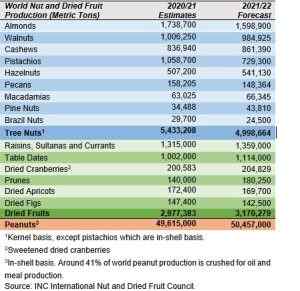
November 2021. With the northern hemisphere harvest completed, the world tree nut production for the 2021/2022 season has been forecasted at about five million metric tons (kernel basis, except pistachios in-shell), down by 8% from 2020/21, but yet following the last decade growing trend and above the 2011/12-2019/20 volumes. Between 2011/12 and 2021/22, tree nut production grew by 54%. In spite of the COVID-19-related disruptions, overall demand remained strong in the 2020/21 marketing year, with most tree nut exports showing increments compared to the prior season and even hitting record international shipments. This season, the global shipment and logistics disruptions are creating some delays and short-term supply shortages, making it a challenge to monitor and assess the situation at any given time.
With the US expecting a shorter crop, almond world production is forecasted down from 2020/21; similarly, due to the top pistachio producers, USA, Iran and Turkey, experiencing good “off years”, total crop is also forecasted lower than the previous season. Global walnut production is anticipated to end up slightly below 2020/21 levels, as China is expecting an average crop and California a shorter one, following last season’s record. A smaller crop of Brazil nuts is also anticipated. Cashew, hazelnut and macadamia 2021/22 crops are foreseen to end up between 3% and 7% up from last season, while the biggest increment is observed for pine nuts, mainly due to larger crops in China and Russia.
World peanut production is expected to amount to about 50.5 M MT, 2% up from 2020/21, with larger crops expected for Nicaragua (14%), Brazil (9%), Nigeria (8%), China (4%), USA (2%) and India (1%).
The world production of dried fruit in 2021/22 has been forecasted at around 3.17 M MT, a growth of 6% compared to 2020/21, as production is expected to increase significantly for prunes and dates, and slightly for dried grapes (raisins, Sultanas and currants) and dried cranberries. Prune production is expected to recover in the USA and Serbia, as well as in Chile and Argentina, which are anticipating a better 2022 harvest. Date production is expected to grow in all origins owing to the expansion of new plantations in North Africa and the Middle East.
Industry Highlight: Cashews India

Production
Over the 2012/13-2021/22 period, India was the world’s largest producer of raw cashew nuts (RCN), averaging 742,800 metric tons of RCN (178,300 MT kernel equivalent) and it is one of the top processors –along with Vietnam. Throughout the last decade, the Indian crop was fairly stable, ranging between a minimum of 160,500 MT (kernel equivalent) in 2012/13 and a maximum of 196,000 MT in 2017/18. With an estimated 2021/2022 production of over 177,100 MT, India currently accounts for 21% of the global cashew production (Figure 1)[5].


 With over 1 million hectares under plantation (according to the latest available survey from 2018/19), the states of Orissa (19% of the country share), Maharashtra (18%), Andhra Pradesh (18%), Tamil Nadu 13%) and Karnataka (12%) account for 79% of the growing area (Figure 2). In the 10-year period between 2008/09 and 2018/19, the cashew planted area in India grew by 22%, with overall increases in all the major growing states with the most significant increment in Orissa (50%). Cultivation in non-traditional areas like the northeastern states has also picked up (Table 1)[6].
High-yielding cultivars were developed and released throughout the country since the 1990s, thanks to the efforts of the Directorate of Cashew Research (DCR), All India Co-ordinated Research Program (AICRP) on Cashew, and State Agriculture Universities (SAUs).
The use of softwood grafting to propagate high-yielding planting material has had a huge impact on enhancing productivity, notably in top-producing states like Orissa and Maharashtra. Canopy and nutrient management, intercropping, precision irrigation, soil and water conservation, high-density planting systems, pruning, rejuvenation of senile orchards, pest management, and other technologies have also all been developed and become available to farmers[7].

Processing
Kernels are the main internationally traded and consumed product of the cashew industry. The cashew nut shell liquid (CNSL) is a valuable subproduct of raw nut processing, which is also traded internationally to be used by the chemical industry. The cashew apple, despite being wasted in large quantities, a small share is generally processed and consumed locally in the form of juice, candy, ham, pickle, or chutney[7,8]. The cashew apple is also used to make feni, a traditional liquor distilled in Goa.
Trade

The leading importing countries for cashew kernels from India are the UAE averaging about 15,500 MT (2016/17-2020/21), followed by the USA, the Netherlands and Japan averaging 8,500 MT, 7,800 and 7,300 MT, respectively. At a region level, the Middle East is the main market, followed by Europe, Asia and North America (Figure 4).

In order to meet the domestic demand and to feed its processing capacity, between 2016/17 and 2020/21, India imported, on average, 804,300 MT of raw cashew nuts from other producing origins worldwide, mainly from Western and Eastern African countries, with Côte d’Ivoire, Benin, Guinea- Bissau, Tanzania and Ghana being the top five suppliers (Figure 5).

Consumption
India has always been a large consumer of broken grades of cashew in-home cooking and as an ingredient for traditional snacks and sweets. This consumption is increasing due to growth in demand of traditional products, coupled with new applications (paste, spread, beverage, etc.). The availability of brokens (as a percentage of total kernel produced) has reduced in the last few years due to better machines. The use of wholes as ingredient along with increased consumption of whole cashews as healthy daily snacks and gifts is adding to the growth of domestic demand.
References
1. Malhotra S.K., Hubballi Venkatesh N. and Nayak M.G. (2017). Cashew: Production, Processing and Utilization of By-products Directorate of Cashewnut and Cocoa Development, Cochin, Kerala, India.
2. Bhoomika, H.R. and Sudha Rani, N, (2018). Problems India - An Overview, Int.J.Curr.Microbiol.App.Sci: 7 (10). doi: https://doi.org/10.20546/ijcmas.2018.710.426.
3. Mahantesh, N. and Manjunatha, P. (2018). Trends in Area, Production, Yield and Export-Import of Cashew in India-An Economic Analysis. Int.J.Curr.Microbiol.App.Sci. 7(12). doi:https://doi.org/10.20546/ijcmas.2018.712.
4. Commodities at a Glance: Special issue on cashew nuts - (N°14 - April 2021) (UNCTAD/DITC/COM/2020/1).
5. INC Database.
6. ICAR-Directorate of Cashew Research, Government of India, https://cashew.icar.gov.in/cashew-statistics-2/.
7. Malhotra S.K., Hubballi Venkatesh N, and Nayak M.G. (2017). Cashew: Production, Processing and Utilization of By-products Directorate of Cashewnut and Cocoa Development, Cochin, Kerala, India.
8. Commodities at a Glance: Special issue on cashew nuts - (N°14 - April 2021) (UNCTAD/DITC/COM/2020/1).
9. INC database.
10. Malhotra S.K., Hubballi Venkatesh N. and Nayak M.G. (2017). Cashew: Production, Processing and Utilization of By products Directorate of Cashewnut and Cocoa Development, Cochin, Kerala, India.
11. Bhoomika, H.R. and Sudha Rani, N. (2018). Problems India - An Overview. Int.J.Curr.Microbiol.App.Sci: 7 (10). doi: https://doi.org/10.20546/ijcmas.2018.710.426.
12. INC Database.
Improved Cashew Varieties and Recommended Package of Practices
Dr. Hubballi joined the Directorate of Cashewnut and Cocoa Development in 1996 after serving in both private and public sector organizations engaged in horticulture development. He also served as Assistant Professor of Horticulture for four years in the University of Agricultural Sciences, Bangalore. Later in 2006 he was appointed as the Director of the Directorate. As head of the organization, he is responsible for formulating the developmental programs for cashew and cocoa in India and also serves as an adviser to the Ministry of Agriculture and Farmers Welfare, Government of India, in matters related to cashew and cocoa development in the country.
India requires a huge quantity of raw cashew nut (1.6 million metric tons) every year to meet the domestic processing sector. While the domestic production is around 800,000 MT, the rest is met by imports from other countries. The research efforts in the country resulted in the identification and development of several high-yielding varieties that are suitable for yield improvement programs. The beneficial effects of the most important agro techniques are used in these varieties to achieve targeted (3-4 folds) yield improvement.
Being a perennial tree, the development of new varieties in the past was based only on the selection of better types from available sources and late crop improvement programs through hybridization. Over 35 selections were made and recommended for cultivation. Crop improvement through hybridization to achieve desired types also resulted in delivering 10-15 hybrids by different cashew research stations of the country.
In general, these varieties can be grouped into three major categories viz., early season fruiting, mid season fruiting and late season fruiting types. Among very early type V-1, K-22-1 under small nut category, Ullal-4, NRCC Sel-2, BLA-39-4 and VRI-3 under medium nut category, and H-130 under very bold nut category are grouped. These varieties respond well to protective irrigation. The small nut types are always bunch bearing type, have more nuts per bunch and heavy yielders. A hybrid H-130 developed at the Directorate of Cashew Research (DCR) Puttur has bold nut, bunch bearing habit and heavy yielder. If correctly managed, all of the above-mentioned varieties have the potential to yield 1-2 MT per hectare.
Good land preparation and deep planting with more organic manures are recommended for better anchorage, faster growth and early yield. Canopy management needs to be initiated in the early years by training the graft by means of side sprout removal to a desired height. Annually pruning off the unwanted shoots, branches after completion of crop harvest will aid the plant to tap more solar energy and more peripheral surface area for flowering and fruiting. High and Ultra density planting systems with suitable recommended varieties, such as VRI-3, H-130, Ullla-1 and other pruning responsive and precocious varieties are needed to harness the early benefits. Intensive care and proper canopy management by pruning and plant protection measures are very essential in the system.
Manure and fertilizer application is a very important practice that must be performed on a regular basis. The dosage of fertilizer recommendation varies in different cashew growing regions. However, 750 g N, 250 g P2O5 and 225 g K20 is a general recommendation that can be followed. This can be followed in 2 3 months before flowering, and a single application is recommended. Foliar application of nitrogenous fertilizers or other nutrients including micronutrients during the fruiting stage also improves yield by 10 15%. Application of fertilizer through fertigation was found to be well suited in terms of fertilizer cost and labor input. The cashew varieties with mid-late and late-season varieties respond well while the early varieties do not require irrigation. The tea mosquito bug (TMB) is a serious pest of cashew. Pest management during flushing, flowering and fruiting is critical to saving the crop.
In India, more than 78% of the plantations are organically grown and under small and marginal land holdings. Only innovative farmers use inorganic fertilizers and adopt integrated pest management systems. Overall, the use of chemicals and fertilizers is kept to the bare minimum.
Health Benefits of Cashews
Nutrition Research
Weight Loss and Management
When looking at cashews and their impact on weight, Nutrients published a study[5] in 2019 that used eighteen healthy individuals in a controlled diet intervention to analyze how bodies absorb energy from cashews. The participants were fed a controlled-based diet for 4 weeks with no additions or with the addition of 42 grams/day of cashews. Once the trial was completed, researchers noted that the mean value of calories ingested from the cashews was 16% lower than what is found on food labels. In other words, not all of the cashew’s calories are absorbed into the body, as some of the fat remains sealed off by the product's fiber. This study was funded by the Global Cashew Council.
Healthy Heart
A separate study[7] in The Journal of Nutrition from 2018 found that with a group of Asian Indians, after a 12-week intervention, cashew consumption was associated with higher levels of HDL cholesterol which is classified as the good type of cholesterol.
Apart from cholesterol, another important aspect of heart health is blood pressure and levels of triglycerides, which are a type of fat in the blood that when elevated can increase risk for cardiovascular disease. A 2019 study[8] in the journal Current Developments in Nutrition examined the role of cashew consumption on these parameters. The results showed that cashew intake was linked to lower blood pressure, and also lower levels of triglycerides.
Additional Health Benefits of Cashews
Antioxidants are helpful in protecting the body’s cells, protecting from disease, and lowering inflammation overall. A 2011 study[10] in Nutrition Research Reviews found that cashews contain polyphenols and carotenoids which are two types of antioxidants that may help improve blood pressure levels and reduce inflammation, among other benefits. So, as you can see, not only are cashews a delicious nut that can be enjoyed as a snack, in sweet or savory, or other ways, but it also gives plenty of potential health benefits!

References
1. Commission Regulation (EU) No 432/2012 of 16 May 2012 establishing a list of permitted health claims made on foods, other than those referring to the reduction of disease risk and to children’s development and health.
2. Regulation (EC) No 1924/2006 of the European Parliament and of the Council of 20 December 2006 on nutrition and health claims made on foods.
3. USDA National Nutrient Database for Standard Reference Legacy Release April, 2018.
4. De Souza, R. G. M., Schincaglia, R. M., Pimentel, G. D., & Mota, J. F. (2017). Nuts and human health outcomes: a systematic review. Nutrients, 9(12), 1311.
5. Baer, D., & Novotny, J. (2019). Metabolizable Energy from Cashew Nuts is Less than that Predicted by Atwater Factors. Nutrients, 11(1), 33.
6. Mah, E., A Schulz, J., N Kaden, V., L Lawless, L., Rotor, J., B Mantilla, L., J Lisk. D. (2017). Cashew consumption reduces total and LDL cholesterol: a randomized, crossover, controlled-feeding trial. The American Journal of Clinical Nutrition.
7. Mohan, V., Gayathri, R., Jaacks, L. M., Lakshmipriya, N., Anjana, R. M., Spiegelman, D., ... & Gopinath, V. (2018). Cashew Nut Consumption Increases HDL Cholesterol and Reduces Systolic Blood Pressure in Asian Indians with Type 2 Diabetes: A 12-Week Randomized Controlled Trial. The Journal of Nutrition, 148(1), 63-69.
8. Mahboobi, S. (2019). The effect of cashew nut on cardiovascular risk factors and blood pressure: a systematic review and meta-analysis (P06-117-19). Current developments in nutrition, 3(Supplement_1), nzz031-P06.
9. Damavandi, R. D., Mousavi, S. N., Shidfar, F., Mohammadi, V., Rajab, A., Hosseini, S., & Heshmati, J. (2019). Effects of daily consumption of cashews on oxidative stress and atherogenic indices in patients with type 2 diabetes: a randomized, controlled feeding trial. International journal of endocrinology and metabolism, 17(1).
10. Bolling, B. W., Chen, C. Y. O., McKay, D. L., & Blumberg, J. B. (2011). Tree nut phytochemicals: composition, antioxidant capacity, bioactivity, impact factors. A systematic review of almonds, Brazils, cashews, hazelnuts, macadamias, pecans, pine nuts, pistachios and walnuts. Nutrition research reviews, 24(2), 244-275.
New Product Launches: Cashews
Even more so, the health benefits of cashews make it a desirable product for those looking to consume more plant-based foods. Below are some products that have been launched from various regions of the world.
 PUREHEART Nutpaste Natural Cashews (India): Made with 99% natural cashew, and coming in an easy-to-use squeeze pack, this cashew paste enables chef-style dishes to be made in the comfort of home. A great vegan alternative for curries and other Indian cuisines. https://pureheart.com/products/pureheartnutpastenatural-cashews-90-gm-99-natural-cashew-completelyplant-based-rich-creamy

Blue Frog Cashew, Almond and Maple (New Zealand): Golden roasted cashews and almonds with a lick of pure maple syrup. 87% nuts and seeds and not a grain in sight, it’s the breakfast you never knew you needed. If you’re nuts about nuts, this cereal is the one for you. https://bluefrogbreakfast.co.nz/product/brand-newcashew-almond-maple/
 New Good Day Cashew Cookie (India): With the abundance of nuts on the surface and a great new taste, the new Good Day Cashew will give its consumers more reasons to love their favorite cookie! http://britannia.co.in/products/good-day/cashew
Nuts for Cheese Un-Brie-Lievable Cashew Product (Canada): She can do anything! Luscious, mild and creamy, this versatile wedge shines alone or as the better half of sweet and savory recipes alike. Made from cashews and dairy-free. https://nutsforcheese.com/vegan-cheeseproducts/

Nature’s Eats Original Cashew Flour (US): An all-natural cashew flour that is perfect for gluten-free baking, shakes and readings. It is Non-GMO Project Verified and has one simple ingredient –cashews. https://natureseats.com/products/the-original-nutflour-cashew/

INC Prepares Latest Webinar on Shipping and Inflation in the Agriculture Industry
We are pleased to announce that the following speakers will present and discuss some of the most relevant topics for the agriculture industry. Indika Dassanayake, Head of Global Accounts and Commercial for CMA CGM Asia Regional Office in Singapore, Bill Rooney, VP of Strategic Development for Kuehne + Nagel from the USA, Peter Friedmann, the Executive Director for the Agriculture Transportation Coalition, the voice of US Agricultural exporters in transportation policy, and Vittavat (Prince) Phonphaisan, the Executive Vice President of Heritage Group, Thailand's leading premium natural food producer and exporter who will discuss the Pacific rim perspective.
The session will be moderated by Emiko Terazono, Commodities Correspondent for the Financial Times, and INC Executive Committee Members Pino Calcagni and Giles Hacking will join in for the group discussion.
Don't miss out on this exciting and insightful webinar with professional industry guest speakers and expert opinions! Save your spot today by registering!
Webinar Speakers
 Indika Dassanayake, Head of Global Accounts and Commercial, CMA CGM Asia Regional Office, Singapore
Indika Dassanayake is the Head of Global Accounts and Commercial for CMA CGM, Asia Pacific Regional Office. Indika has 28 years of experience in the shipping industry covering Sri Lanka, Indonesia, Bangladesh and Pakistan before moving to Singapore. He has held various management roles in Operations, Customer Service, Sales, Logistics and Geographies. He helmed the commercial arm of APL prior to its acquisition by the CMA CGM Group. The group provides global supply chain services in shipping and logistics covering over 160 countries globally. Indika is Fellow of the Institute of Chartered Shipbroker’s, London.
 Bill Rooney, VP of Strategic Development, Kuehne + Nagel, USA
William F. Rooney has 48 years of experience in transportation management covering a broad range of business functions. He is currently Vice President, Strategic Development for Kuehne + Nagel Inc. and has been with Kuehne + Nagel for 10 years. Prior to Kuehne + Nagel Mr. Rooney’s positions have included President of Hanjin Shipping America; Senior Vice President, Service Delivery for CMA-CGM; and Vice President, Ocean Services for GT Nexus, a logistics software provider. He also held a number of senior management positions with Sea-Land Service over a span of 25 years including 5 years in Europe. Mr. Rooney’s board memberships have included: the Pacific Maritime Association, the Pacific Merchant Shipping Association, The US Maritime Alliance, Consolidated Chassis Management, OCEMA, and the Maritime Association of the Port of New York and New Jersey.
 Peter Friedmann, Executive Director, Agriculture Transportation Coalition, USA
 Vittavat (Prince) Phonphaisan, Executive Vice President, Heritage Group, Thailand
Webinar Moderator
 Emiko Terazono, Commodities Correspondent, Financial Times, UK
Sponsorship Opportunities
For more information about the benefits of each sponsorship level, you can email Marta Ballesté at marta.balleste@nutfruit.org.

Shipping Challenges and Inflationary Pressure in the Agriculture Sector Webinar
We are pleased to announce that the following speakers will present and discuss some of the most relevant topics for the agriculture industry. Indika Dassanayake, Head of Global Accounts and Commercial for CMA CGM Asia Regional Office in Singapore, Bill Rooney, VP of Strategic Development for Kuehne + Nagel from the USA, Peter Friedmann, the Executive Director for the Agriculture Transportation Coalition, the voice of US Agricultural exporters in transportation policy, and Vittavat (Prince) Phonphaisan, the Executive Vice President of Heritage Group, Thailand's leading premium natural food producer and exporter who will discuss the Pacific rim perspective.
The session will be moderated by Emiko Terazono, Commodities Correspondent for the Financial Times, and INC Executive Committee Members Pino Calcagni and Giles Hacking will join in for the group discussion.
This session will last 90 minutes.
Time zones: Thursday 2, 6:00-7:30 am PST | 3:00-4:30 pm CET | 7:30-9:00 pm IST | 10:00-11:30 pm CST | Friday 3, 1:00-2:30 am AEDT.
Labeling Update: November 24, 2021
Saudi Arabia and Taiwan Consider New Labeling Requirements
These new labeling requirements will primarily affect products being sold in retail channels.
Go and check new measures from each country:
- Saudi Arabia: draft technical regulation with the procedures for placing nutritional data in the form of traffic light signals on the labels of pre-packaged food products.
- Taiwan: revisions to regulations for nutrition claims on prepackaged food products.