
Perspective: Plant-based Whole-Grain Foods for Chronic Kidney Disease: The Phytate-Phosphorus Conundrum.
Restriction of dietary phosphorus intake is an important component of good clinical practice in kidney failure patients, particularly after dialysis initiation. Greater consumption of predominantly plant-based diets, including phytate-rich foods, is increasingly recommended for health maintenance/disease prevention in this population, with the implicit assumption that phytate-phosphorus in whole-grain cereals, legumes, pulses, and nuts is poorly absorbed. Review of human interventions with diets high in phytate-phosphorus indeed suggests an absorption of at least 50%, still less than animal protein–bound phosphorus, but higher than the generally believed 10–30%. Factors largely ignored up to now, but of potential influence on phytate-phosphorus bioavailability, include effect of food processing in releasing phosphorus, action of colonic bacteria that are able to release inorganic phosphorus, and capacity of the colon to absorb phosphorus. These issues may become increasingly important as new plant-based alternatives to meats, all containing phytate, are being rapidly introduced in the market. https://doi.org/10.1093/advances/nmab066

Dried plum consumption improves bone mineral density in osteopenic postmenopausal woman: A case report.
The use of non-pharmacological alternatives to pharmacological interventions, e.g., nutritional therapy, to improve or maintain bone mineral density (BMD) in postmenopausal women has gained traction over the past decade, but limited data exist regarding its efficacy. The purpose of this case report was to compare changes in BMD of an osteopenic postmenopausal woman over the course of 28 months, including an abrupt change in diet. For the first 12 months, a participant assigned to the control arm of a randomized controlled trial (RCT) only took calcium and vitamin D3 supplements, but in the following 16 months after completing the RCT, she introduced and maintained daily consumption of 50 g of dried plums in addition to calcium and vitamin D3 supplements. This case report provides a unique opportunity to follow the trajectory of distinct changes in bone in response to one dietary modification. https://doi.org/10.1016/j.bonr.2021.101094
Walnut intake, cognitive outcomes and risk factors: a systematic review and meta-analysis.
Background: Walnuts contain nutrients that are associated with improved cognitive health. To our knowledge, no review has systematically examined the effects of walnuts on cognitive function and risk for cognitive decline. Objective: To conduct a systematic review and meta-analysis evaluating the effects of walnut intake on cognition-related outcomes and risk-factors for cognitive decline in adults. Methods: Medline®, Commonwealth Agricultural Bureau, and Cochrane Central Register of Controlled Trials were searched for randomized controlled trials (RCTs) and observational studies published until April 2020 on walnut intake, cognition (e.g. cognitive function, stroke, and mood), and selected risk factors for cognitive decline (e.g. glucose homeostasis and inflammation). Risk-of-bias and strength-of-evidence assessments were conducted using standard validated tools. Random-effects meta-analyses were conducted when ≥3 studies reported quantitative data for each outcome. Results: 32 RCT and 7 observational study publications were included. Meta-analysis of cognition-related outcomes could not be conducted due to heterogeneity of tests. None of the 5 cognition RCTs found significant effects of walnuts on overall cognition, although 3 studies found improvements on subdomains and/or subgroups. All 7 observational studies found significant associations and a dose-response relationship between walnut intake and cognition-related outcomes. Meta-analyses of 27 RCTs reporting glucose homeostasis and inflammation outcomes, selected risk factors for cognitive decline, did not show significant effects of walnut intake. Conclusions: Due to the non-uniformity of tests for cognition-related outcomes, definitive conclusions regarding the effect of walnut consumption on cognition could not be reached. Additionally, evidence does not show associations between walnut intake and glucose homeostasis or inflammation, cognitive decline risk-factors. High-quality studies with standardized measures are needed to clarify the role of walnuts in cognitive health. KEY MESSAGES. This is a systematic review and meta-analysis of 5 randomized clinical trials and 7 observational study articles of the impact of walnut intake on cognition decline and 27 randomized clinical trials of the effect of walnut intake on risk factors for cognitive decline including glucose homeostasis and inflammation. The non-uniformity of tests performed to measure cognitive function in the various studies did not allow for a meta-analysis of these studies. A definitive conclusion could therefore not be reached regarding the effect of walnut intake on cognitive decline. The evidence available does not show an association between walnut intake and glucose homeostasis or inflammation. https://doi.org/10.1080/07853890.2021.1925955
In vitro gastrointestinal digestion and simulated colonic fermentation of pistachio nuts determine the bioaccessibility and biosynthesis of chronobiotics.
Chronodisruption leads to obesity and other metabolic disorders that can be alleviated by food-derived potential chronobiotics, such as phytomelatonin (PMT), phenolic compounds (PCs) and dietary fiber rich pistachios. Pistachios with (PN + SC) or without (PN) the seed coat were investigated for their in vitro chronobiotic potential since they are one of the main reported PMT sources. Consequently we evaluated the bioaccessibility, permeability, and biosynthesis of pistachio chronobiotics, particularly PMT, during gastrointestinal and colonic fermentation. The maximum in vitro bioaccessibility and apparent permeability (efflux-prone) of PCs, flavonoids and PMT were sample-specific [∼1.3% (both), 27 and 3.4% (PN + SC)], but additional amounts (flavonoids > PCs > PMT) were released under simulated colonic conditions. Short-chain fatty acids (SCFAs; 38 mM; >50% butyrate, PN + SC > PN) and some metabolites (e.g., indole, benzaldehyde, phenolic acids, and aliphatic/aromatic hydrocarbons) were detected depending on the sample. The predominant pistachio butyrate production during in vitro colonic fermentation can improve chronodisruption and benefit obese individuals. Pistachio's digestion increases the bioaccessibility and intestinal permeability of potential chronobiotics (PMT and PCs) and the biosynthesis of colonic metabolites (SCFAs, among others) also with chronobiotic potential. https://doi.org/10.1039/D0FO02708A
Walnuts, Long-Chain Polyunsaturated Fatty Acids, and Adolescent Brain Development: Protocol for the Walnuts Smart Snack Dietary Intervention Trial.
Background: Adolescence, when the most complex behaviors are refined to adult sophistication, represents a major window of opportunity and vulnerability for neuropsychological development. To support and protect this complex and active brain growth, different nutritional components considered essential need to be acquired from the diet. For instance, omega-3 fatty acids are mainly obtained from seafood, seeds, and walnuts. Known for their rich lipid profile, walnuts contain sizable amounts of an essential fatty acid, alpha-linolenic acid (ALA), the vegetable omega-3 fatty acid that is the precursor of two longer-chain omega-3 polyunsaturated fatty acids (omega-3 PUFA): docosahexaenoic (DHA) and eicosapentaenoic (EPA) acids. While there is growing evidence of neuropsychological improvements in the young developing brain associated with omega-3 PUFA intake, few studies have examined whether consuming walnuts during adolescence entails similar beneficial effects. There is a need to further explore the ways in which walnuts influence youthful brain function, particularly for the long-term. Thus, we designed the WALNUTs study (WSS), a population-based randomized controlled trial conducted in adolescents in Barcelona, Spain. We hypothesize that walnut intake will increase omega-3 PUFA tissue availability (particularly ALA) to a level that enhances the neuropsychological development during adolescence. Methodology/Design: We conducted a 6-month population-based randomized controlled trial in teenagers (n = 800) and we aimed to determine the effectiveness of the intervention (four walnuts per day, or 30 kernel g, ~1.5g of ALA) in enhancing brain neuropsychological and socio-emotional development compared to a control group with no walnut intervention. Before randomization, different neuropsychological tests were recorded for all participants, and blood samples (in a subsample of participants) were collected to measure omega-3 PUFA levels at baseline, and all again, after randomization and the intervention. The data is now collected and we will conduct linear regression models to assess the effect of the intervention. Discussion: The WALNUTs (WSS) study results will allow us to better understand the role of plant-based omega-3 PUFA intake from regular walnut consumption on neuropsychological development during adolescence. Results could be translated into nutritional public health recommendations targeting teenagers. Trial Registration: ClinicalTrials.gov, U.S. National Library of Medicine, National Institutes of Health # NCT02590848. Retrospectively registered 29/10/2015. https://doi.org/10.3389/fped.2021.593847
Anti-obesity potential of almond (Prunus dulcis) in experimental animals under cafeteria and atherogenic diets.
Background & objectives: Natural dietary supplements are progressively getting famous to supplant synthetic substances particularly in chronic morbidities. The aim of this study was to evaluate the anti-obesity potential of almond on the normal, Cafeteria, and Atherogenic diets. Materials and methods: Parameters such as change in body weight, body temperature, lipid profile, organ weights, and fat pad weights were assessed. Central Nervous System related studies (Despair Swim test and Elevated Plus maze test) were also performed to comprehend the effect of the diets, and almond on the brain. All of the experimental animals were randomly assigned to one of three diet categoriesregular, cafeteria, or atherogenic, and fed those diets for 40 days. Each diet had the control group, standard drug group and three almond groups (low dose: 50; medium dose: 100 and high dose: 200 mg/kg body weight). Body weight was recorded every alternate day. On 40th day, body temperature was measured. On day 41, lipid parameters, organ weights, fat pad weights and the CNS parameters were evaluated. ANOVA followed by Duncans Multiple Range Test were used for statistical analysis. Results: Treatment of animals with either a low or high dose of almond as well as a standard herb prevented a rise in body weight significantly (p = 0.01) in all three diet groups. When a regular diet was replaced with a cafeteria and atherogenic diet, the serum levels of triglycerides and LDL increased significantly, while HDL levels decreased significantly. Overall, almond preparation reduced lipid parameters, organ weights, fat-pad weights, and stabilized CNS parameters substantially. Interpretation & conclusion: The almond high dose was the most effective of all the almond preparations. Our study suggests that chronic administration of almond independently reduces the body weight in experimental animals. https://doi.org/10.1016/j.sjbs.2021.04.024
The Relationship of Tree Nuts and Peanuts with Adiposity Parameters: A Systematic Review and Network Meta-Analysis.
The network meta-analysis and systematic review conducted aim to comparatively assess the effects of tree nuts and peanuts on body weight (BW), body mass index (BMI), waist circumference (WC), and body fat percentage (BF%). A systematic search up to 31 December 2020 was performed. A random-effects network meta-analysis was conducted following the PRISMA-NMA statement. A total of 105 randomized controlled trials (RCTs) with measures of BW (n = 6768 participants), BMI (n = 2918), WC (n = 5045), and BF% (n = 1226) were included. The transitivity assumption was met based on baseline characteristics. In the comparisons of nut consumption versus a control diet, there was no significant increase observed in any of the adiposity-related measures examined except for hazelnut-enriched diets, which raised WC. Moreover, almond-enriched diets significantly reduced WC compared to the control diet and to the pistachio-, mixed nuts-, and hazelnut-enriched diets. In subgroup analyses with only RCTs, designed to assess whether nut consumption affected weight loss, almonds were associated with reduced BMI and walnuts with reduced %BF. The evidence supports that: (1) tree nut and peanut consumption do not influence adiposity, and (2) compared to a control diet, the consumption of almond-enriched diets was associated with a reduced waist circumference. https://doi.org/10.3390/nu13072251
Dried Grapes 2021/2022 Early Forecast
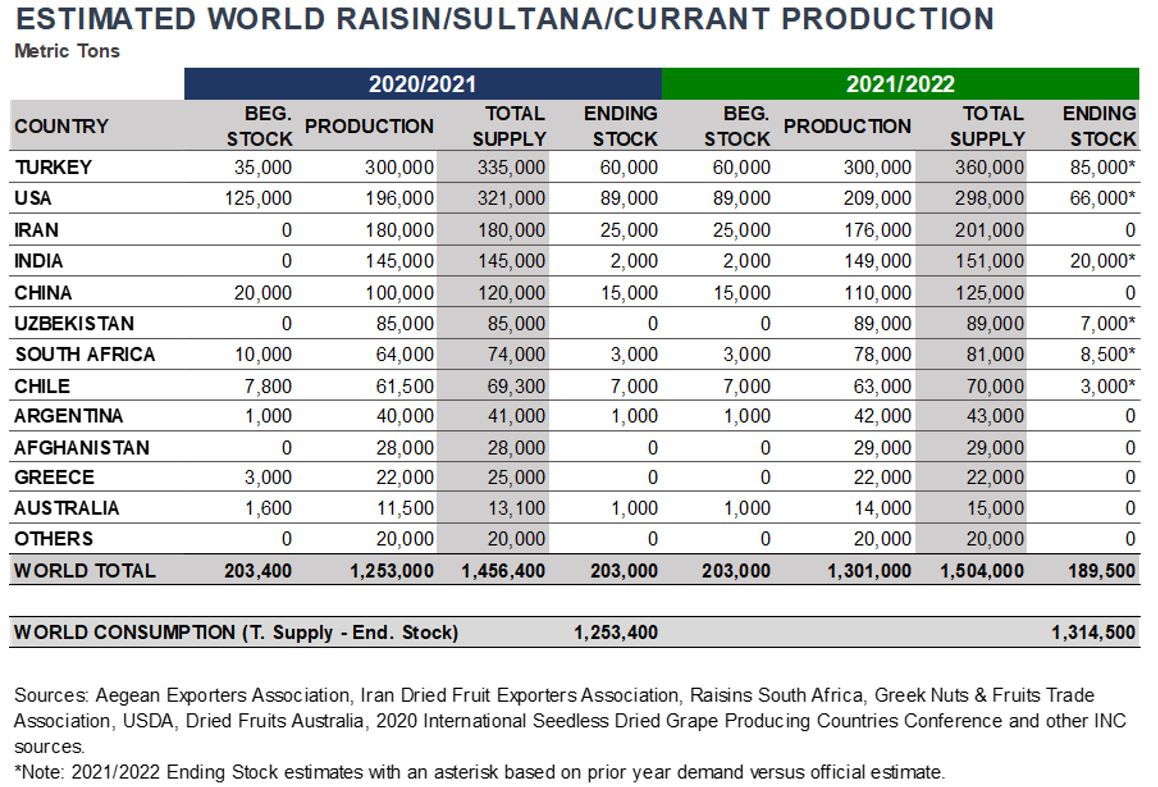
As discussed during the latest INC Online Conference, held during May 25-27, total dried grape (raisins, Sultanas and currants) supply in 2021/2022 is forecasted to remain fairly stable (3% up from 2020/21), as planted areas are not expanding in the top production origins. The beginning stock in 2020 was around 203,400 metric tons and it is estimated to be roughly the same in 2021 (203,000 MT). Carry out for the 2021/22 season, preliminary forecasted 7% below compared to 2021/22, at 189,500 MT, is optimistic from a sales standpoint. There is not a big shift in supply expected for any of the major suppliers.
On the demand side, although 2020 did see a big raise in retail consumption, it was traded off by the drop in HORECA sales. Due to normalizing and opening up after the pandemic, a slight increase in demand is projected for the incoming months.
Turkey
According to the Turkish Statistical Institute data, international shipments from January to April were reduced from 77,388 MT in 2020 to 63,240 in 2021, about 18%. This could be partly due to the COVID-19 aftermath as well as the shipping disruptions. However, most of the 60,000 MT of carry-over is mainly composed of the fruit bought by TMO.
USA
As per the USDA Global Agricultural Trade System (GATS) database, international shipments out of California year to date (January-April, 2021) were slightly reduced by 8% to 26,083 MT from the 28,398 MT exported during the same period in 2020. However, exports to Taiwan (1,593 MT), the Philippines (1,508 MT) and South Korea (1,158 MT), were significantly increased by 71%, 53%, and 51%, respectively from the last year.
China
South Africa
Due to the smaller-than-average crop in 2020, the total stock inventory is expected to be almost fully sold out, so, opening stock for the 2021/22 season is currently estimated at 3,000 MT. The early production guestimates for this season place the farmer stock production at around 86,000 MT, with 78,000 MT of marketable product, as production is expected to come back to normal volumes.
Brief COVID-19 Update: July 7, 2021
The Delta variant is capturing much of the attention. Cases of the Delta variant have been reported in 98 countries and “is spreading quickly in countries with low and high vaccination coverage”, warned Dr. Tedros Adhanom, Head of the World Health Organization (WHO). Fortunately, vaccines from Pfizer Inc. and AstraZeneca Plc have shown high effectiveness after two doses at preventing hospitalization of those infected with the Delta variant. The Johnson & Johnson Single-Shot vaccine has also shown strong neutralizing antibody activity against the Delta variant.
According to Bloomberg, the 3.22 million doses administered to date should be enough to fully vaccinate 21% of the global population, but inequitable vaccination is a reality. In the EU/EEA, the median cumulative uptake of at least one vaccine dose among adults aged 18 years and above is 62% and 39% for full vaccination. In the US, 54.6% of the population has received at least one dose of a COVID-19 vaccine.
Travel restrictions are constantly being updated to prevent COVID-19 new cases and variants. On July 1, the European Council added 10 countries and one entity/territorial authority to the list of countries for which travel restrictions should be lifted: Armenia, Azerbaijan, Bosnia and Herzegovina, Brunei Darussalam, Canada, Jordan, Montenegro, Qatar, Republic of Moldova, Saudi Arabia and Kosovo. The UK also updated the red, amber and green list rules for entering England on June 30. Among others, the Dominican Republic, Eritrea, Haiti, Mongolia, Tunisia and Uganda moved from amber to the red list.
Cashew Crop 2021/2022 Forecast
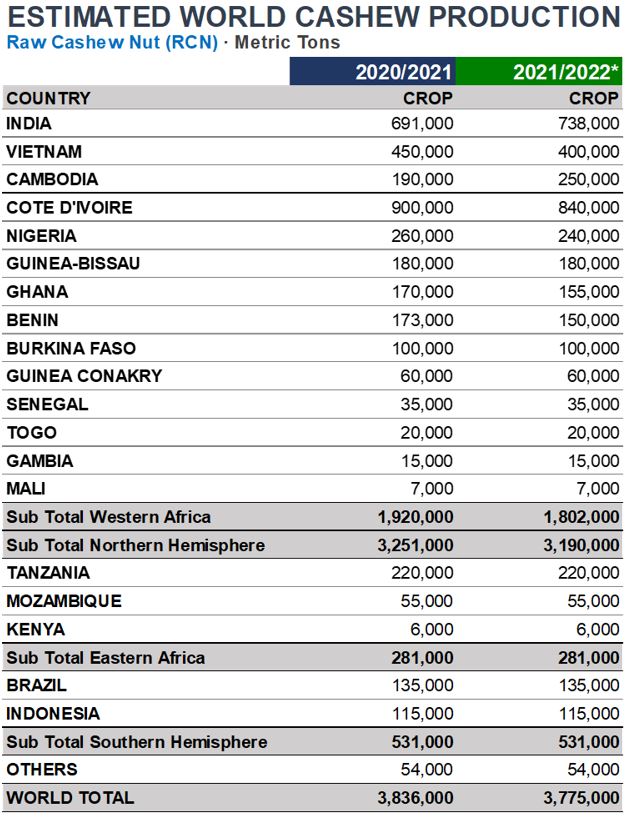

The total crop for the 2020/2021 season is estimated at 3.8 million metric tons, and the 2021/22 crop, is expected to be very similar to the previous season. The difference is about a 2% reduction in the crop size, primarily on account of the lower estimated crops in West Africa (down 6% from 2020/21) and in Vietnam (down 11%), which are being compensated, to some extent, with a good crop in Cambodia (up 32%). The main decreases in West Africa are forecasted for Côte d’Ivoire (7%), mainly due to drought, Nigeria (8%), Ghana (9%), and Benin (13%). No changes are anticipated for the rest of the origins.
The main challenges that the industry was facing, at the time of writing this report, were related to the logistic issues affecting the whole goods transportation industry. In Africa, containers and vessels availability were hampering the raw material flow towards the Asian processors, while kernels shipments from Asia to Europe were also slowed down since October last year. At this time, shipping rates started to raise and kept following that trend towards the first semester of 2021. The availability of kernels almost stopped in Europe and was very limited in the US.
In spite of the disruption in the movement of raw material into India and Vietnam, due to the domestic crop's harvest, there was not yet a shortage of raw cashew at the processing facilities. However, once the nuts got processed, the availability of empty containers was low, getting a booking extremely difficult, the freight rate was excessive and the transit times had expanded. Even upon arrival, there were difficulties to transport the containers to warehouses as trucking rates, in the US and Europe, had gone through the roof.
On the demand side, during the first quarter of 2021, imports into Europe and the US were increased between 3 to 7%, as the demand for cashews was still going up. Due to the lesser kernel availability from Asia, prices are likely to at least stabilize, or even go up. The price trend seems to show the beginning of a price recovery in 2021 after a stiff decline in 2019 and 2020. In India, demand, which has been heavily affected by COVID-19 last year, is anticipated to improve in the second half of this year.