
Rare Earths as Authenticity Markers for the Discrimination of Greek and Turkish Pistachios Using Elemental Metabolomics and Chemometrics
Pistachios are a nutritionally beneficial food source widely consumed all over the world. Pistachios exhibit high content of antioxidants, vitamins and other beneficial micronutrients, including nutrient elements and rare earth elements (REEs). Considering that the concentration of REEs depends on the climate and soil characteristics that vary among different geographical regions, REEs could constitute markers responsible for the geographical discrimination of this nut type. In this study, Greek pistachios with a protected designation of origin (PDO) label from Aegina Island and Fthiotida and Turkish pistachios from Adana were analyzed with inductively coupled plasma mass spectrometry (ICP-MS) to assess their REE profile. La, Ce, Pr, Nd, Sm, Eu, Gd, Tb, Dy, Ho, Er, Tm and Yb were determined and quantified. The quantification results were further analyzed using the main effect plot, permutational analysis of variance (PERMANOVA), nonmetric multidimensional scaling (nMDS), principal component analysis (PCA) and hierarchical clustering (HCA) to investigate the similarities between the pistachios. A decision tree (DT) was developed for the classification of pistachios according to their geographical origin proving to be a promising and reliable tool for verifying the authenticity of food products on the basis of their REE profile.

Aflatoxin reduction in nuts by roasting, irradiation and fumigation: a systematic review and meta-analysis
The present study aimed to investigate the reduction of aflatoxins as a potent hazard for human health in nuts during roasting, irradiation, and fumigation processes. A systematic search was performed in PubMed, Scopus, and ISI Web of Science on 6 April 2020 to find interventional studies assessing the effects of roasting, fumigation, and irradiation methods on total and individual aflatoxins concentration in nuts. Study-specific results were pooled by using a random-effects model. A total of 19 trials were included in the analyses. In most studies, the influence of method on aflatoxin reduction was assessed on peanuts. The results showed that the roasting method significantly reduced aflatoxin B1, B2, G1, and G2 concentrations by 46.91%, 30.66%, 40.88%, and 26.19%, respectively. Such results for the fumigation method were 20.88% and 22.56% for aflatoxin B1 and aflatoxin total, respectively. There was a 58.60% reduction in aflatoxin B1 and a 74.97% reduction in aflatoxin total concentrations in nuts following the irradiation method. The findings indicated that the evaluated processes could be influential for reducing aflatoxin levels in nuts.
Walnut (Juglans regia L.) Volatile Compounds Indicate Kernel and Oil Oxidation
Kernel oxidation susceptibility and pellicle darkening are among the biggest concerns regarding walnut quality. Monitoring oxidation is crucial to preserve quality from production to consumption. Chemical oxidation parameters (peroxide value and UV absorbances), fatty acid profile, tocopherols, phenols, and volatiles in 'Chandler' and 'Howard' kernels were studied at different time points during 28 weeks of storage to evaluate potential oxidation markers. During storage, peroxide value, UV absorbances, and volatiles concentration increased; oxidative stability, phenols, and tocopherols decreased, while fatty acid profile was unaffected. 'Chandler' had a lower peroxide value, K232, and K268; and higher kernel and oil oxidative stability compared to 'Howard'. Phenols and tocopherols decreased 1.2-fold in 'Chandler' and 1.3-fold in 'Howard'. Using multivariate analysis, samples were discriminated in three groups according with their oxidative levels. Increases of volatiles in oil and kernel were associated with higher oxidative levels. Pentanal, 2-methylpropanal, hexanal, (E)-2-pentenal, 3-octanone, octanal, (Z)-2-penten-1-ol, hexanol, (E)-2-octenal, 1-octen-3-ol, benzaldehyde, (E,E)-2,4-nonadienal, and hexanoic acid in kernels were adequate at distinguishing oxidation levels and as oxidative markers in walnuts. Kernel volatiles is a useful measurement for walnut oxidation during storage without any prior fat extraction.
Survival and Inactivation by Advanced Oxidative Process of Foodborne Viruses in Model Low-Moisture Foods
Enteric viruses, such as human norovirus (NoV) and hepatitis A virus (HAV), are the major causes of foodborne illnesses worldwide. These viruses have low infectious dose, and may remain infectious for weeks in the environment and food. Limited information is available regarding viral survival and transmission in low-moisture foods (LMF). LMFs are generally considered as ready-to-eat products, which undergo no or minimal pathogen reduction steps. However, numerous foodborne viral outbreaks associated with LMFs have been reported in recent years. The objective of this study was to examine the survival of foodborne viruses in LMFs during 4-week storage at ambient temperature and to evaluate the efficacy of advanced oxidative process (AOP) treatment in the inactivation of these viruses. For this purpose, select LMFs such as pistachios, chocolate, and cereal were inoculated with HAV and the norovirus surrogates, murine norovirus (MNV) and feline calicivirus (FCV), then viral survival on these food matrices was measured over a four-week incubation at ambient temperature, by both plaque assay and droplet-digital RT-PCR (ddRT-PCR) using the modified ISO-15216 method as well as the magnetic bead assay for viral recovery. We observed an approximately 0.5 log reduction in viral genome copies, and 1 log reduction in viral infectivity for all three tested viruses following storage of select inoculated LMFs for 4 weeks. Therefore, the present study shows that the examined foodborne viruses can persist for a long time in LMFs. Next, we examined the inactivation efficacy of AOP treatment, which combines UV-C, ozone, and hydrogen peroxide vapor, and observed that while approximately 100% (4 log) inactivation can be achieved for FCV, and MNV in chocolate, the inactivation efficiency diminishes to approximately 90% (1 log) in pistachios and 70% (< 1 log) in cereal. AOP treatment could therefore be a good candidate for risk reduction of foodborne viruses from certain LMFs depending on the food matrix and surface of treatment.
2021 Trends of Chilean Walnut Crops
ProChile and Chilenut invite you to join them in this webinar to learn about Chilean walnut production, its characteristics, benefits, and forecasts for its 2021 crop.
https://www.prochile.gob.cl/difusion/difusion2021/febrero/nueces_chile/std.html
Register Now for Shipping Challenges in a COVID-19 World, an Interview with MSC
During this webinar, the INC will interview MSC Mediterranean Shipping Company Trade Manager, Corrado Carosella, about the impact the pandemic is having on global container shipping. We will discuss the current state of the shipping industry and the prospects for the future. How container shipping services have been impacted by COVID-19? What has triggered shipping costs to rise? How is MSC managing the crisis?
Moreover, after the interview, there will be a Q&A session. In total, the webinar will last for one hour. You will not want to miss this exciting and informative webinar! Register now!
Sponsorship opportunities are still available and with a niche audience, this is a can't-miss chance to showcase your brand! If you are interested in sponsoring, please reach out to Marta Ballesté at marta.balleste@nutfruit.org.
Corrado Carosella, Trade Manager, MSC Mediterranean Shipping Company

Born in Genoa, Italy in 1973, Corrado obtained a Law degree at Universita’ degli Studi di Genova before embarking on his career in shipping. His professional journey involved him moving to Houston, Texas in 2005 to work for MSC USA where he looked after VIP customers and worked as a Far East Trade Manager, among other roles. After a stint managing VIP customers in Charleston, South Carolina, Corrado transferred to MSC's global headquarters in 2011 and is now responsible for 7 liner services, working in close collaboration with the rest of MSC's Liner Department and management in Geneva.
Thanks to all our sponsors.

|
|
 |

Register Now for Shipping Challenges in a COVID-19 World, an Interview with MSC
During this webinar, the INC will interview MSC Mediterranean Shipping Company Trade Manager, Corrado Carosella, about the impact the pandemic is having on global container shipping. We will discuss the current state of the shipping industry and the prospects for the future. How container shipping services have been impacted by COVID-19? What has triggered shipping costs to rise? How is MSC managing the crisis?
Moreover, after the interview, there will be a Q&A session. In total, the webinar will last for one hour. You will not want to miss this exciting and informative webinar! Register now!
Sponsorship opportunities are still available and with a niche audience, this is a can't-miss chance to showcase your brand! If you are interested in sponsoring, please reach out to Marta Ballesté at marta.balleste@nutfruit.org.
Corrado Carosella, Trade Manager, MSC Mediterranean Shipping Company
Born in Genoa, Italy in 1973, Corrado obtained a Law degree at Universita’ degli Studi di Genova before embarking on his career in shipping. His professional journey involved him moving to Houston, Texas in 2005 to work for MSC USA where he looked after VIP customers and worked as a Far East Trade Manager, among other roles. After a stint managing VIP customers in Charleston, South Carolina, Corrado transferred to MSC's global headquarters in 2011 and is now responsible for 7 liner services, working in close collaboration with the rest of MSC's Liner Department and management in Geneva.
Thanks to all our sponsors.
|
|
|
Shipping Challenges in a COVID-19 World, an Interview with MSC
All of these topics will be covered to shed light on the world of shipping during these unpredictable times. You won't want to miss it, So join us on March 11, 2021, at 4:00pm CET! More information.
Thanks to all our sponsors.
|
|
 |

Pistachios Crop Progress Report
USA Pistachio Crop Progress Report
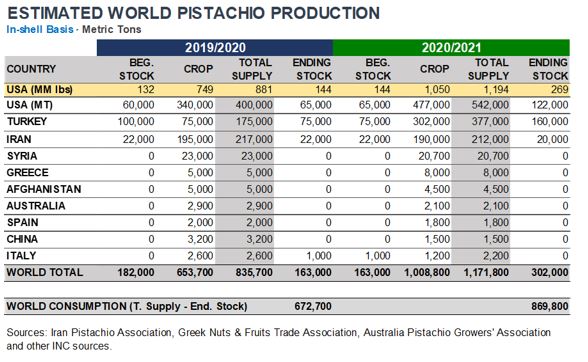
US shipments last year added up to over 266,000 metric tons (588 million lbs.). This year’s demand leading up to Chinese New Year and US sales during the holiday season remained consistent with the prior year and is anticipated to remain strong overall. Crop to date US shipments as of November amounted to 93,800 metric tons (207 MM lbs.), 3% up compared to last’s year November crop to date of 91,100 metric tons (201 MM lbs.). Several factors affecting sales last year are continuing to be challenges this year: along with the increase in Iranian supply, additional tariffs between China and the US, and the impact of COVID-19 in the export market, shipment issues are creating near-term shortages.
Iran Pistachio Crop Progress Report
Exports to the Far East amounted to 57,000 MT; three times up from the same period the previous year. YTD shipments to India reached 14,000 MT, up 75% compared to 2019, followed by the EU with 7,000 MT.
Demand for larger pistachio nut varieties has been exceptional this year. Hence, it is assumed that the largest share of the remaining inventory consists of Fandoghi variety. Natural kernel demand has also been very strong in different markets due to its price attractiveness.
Turkey Pistachio Crop Progress Report
Spain Pistachio Crop Progress Report
Pistachios Crop Progress Report
USA Pistachio Crop Progress Report
US shipments last year added up to over 266,000 metric tons (588 million lbs.). This year’s demand leading up to Chinese New Year and US sales during the holiday season remained consistent with the prior year and is anticipated to remain strong overall. Crop to date US shipments as of November amounted to 93,800 metric tons (207 MM lbs.), 3% up compared to last’s year November crop to date of 91,100 metric tons (201 MM lbs.). Several factors affecting sales last year are continuing to be challenges this year: along with the increase in Iranian supply, additional tariffs between China and the US, and the impact of COVID-19 in the export market, shipment issues are creating near-term shortages.
Iran Pistachio Crop Progress Report
Exports to the Far East amounted to 57,000 MT; three times up from the same period the previous year. YTD shipments to India reached 14,000 MT, up 75% compared to 2019, followed by the EU with 7,000 MT.
Demand for larger pistachio nut varieties has been exceptional this year. Hence, it is assumed that the largest share of the remaining inventory consists of Fandoghi variety. Natural kernel demand has also been very strong in different markets due to its price attractiveness.