
Peanuts as a nighttime snack enrich butyrate-producing bacteria compared to an isocaloric lower-fat higher-carbohydrate snack in adults with elevated fasting glucose: A randomized crossover trial.
Background: Tree nuts have glucoregulatory effects and influence gut microbiota composition. The effect of peanuts on the microbiota has not been investigated. Objectives: The aim was to examine the effect of 28 g/d of peanuts for 6-wks, compared to an isocaloric lower-fat higher-carbohydrate (LFHC) snack, on gut microbiota composition. A secondary aim was to identify functional and active compositional differences in a subset of participants using metatranscriptomics. Methods: In a randomized, crossover trial, 50 adults (48% female; 42 ± 15 y; BMI 28.3 ± 5.6 kg/m2; plasma glucose 100 ± 8 mg/dL) consumed 28 g/d of dry roasted, unsalted, peanuts (164 kcal; 11% E carbohydrate, 17% E protein, 73% E fat, and 2.4 g fiber) or a LFHC snack (164 kcal; 53% E carbohydrate, 17% E protein, 33% E fat, and 3 g fiber) for 6-wk (4-wk washout period). Gut bacterial composition was measured using 16S rRNA sequencing in the whole cohort. Exploratory metatranscriptomic analyses were conducted on a random subset (n = 24) of samples from the Peanut condition. Results: No between-condition differences in α- or β- diversity were observed. Following peanut intake, Ruminococcaceae were significantly more abundant [Linear discriminant analysis score (LDA) = 2.8; P = 0.027)] compared to LFHC. Metatranscriptomics showed increased expression of the K03518 (aerobic carbon-monoxide dehydrogenase small subunit) gene following peanut intake (LDA = 2.0; P = 0.004) and Roseburia intestinalis L1-82 was identified as a contributor to the increased expression. Conclusion: An increased abundance of Ruminococcaceae was observed following consumption of 28 g/d of peanuts in adults with elevated fasting glucose after 6-wks. Metatranscriptomics revealed increased expression of the K03518 gene. These results suggest peanut intake enriches a known butyrate producer and the increased expression of a gene implicated in butyrate production adds further support for peanut-induced gut microbiome modulation. https://doi.org/10.1016/j.clnu.2022.08.004

Nuts as functional foods: Variation of nutritional and phytochemical profiles and their in vitro bioactive properties
The aim of the present study was to examine the nutritional (fat, fatty acids, minerals, sugars) and bioactive compounds (polyphenols, tocochromanols, triterpene) and their influence on in vitro anti-diabetic (pancreatic α-amylase and intestinal α-glucosidase), anti-obesity (pancreatic lipase) and anti-cholinergic (AChE and BuChE) inhibitory activity of 8 different popular nuts-pecan, pine, hazelnuts, pistachio, almonds, cashew, walnuts, and macadamia. The total content of phenolic compounds in nuts ranged from 432.9 (walnuts) to 5.9 (pistachio) mg/100 g. The dominant polyphenols are polymeric procyanidins (walnuts - 415.1 mg/100 g). Nuts are rich in tocochromanols (832.9-4377.5 μg/100 g), especially α- and γ-tocopherols. The highest content of α-tocopherol (vitamin E) was detected in hazelnuts and almonds (2551.0 and 2489.7 μg/100 g, respectively) while the lowest amounts were detected in macadamia, cashew and walnuts. The most abundant in nuts are oleanic and pomolic acids (35 and 22 % of total, respectively), while betulin, uvaol and erythrodiol are less characteristic triterpenes for nuts (<1%). Pine nuts are the nuts with the highest content of triterpene (690.3 mg/100 g). Pistachio and almonds are the richest in total fat (>45 %), but monounsaturated (17.5-79.3 %; hazelnuts, almonds, cashew, macadamia, pistachio and pecan) and polyunsaturated (7.5-69.3 %; pine, walnuts) are the dominant fatty acids. Moreover, nuts are low in Cu, Zn, Mn and Na content, but rich in K (464.5-1772.3 mg/100 g) and Mg (197.0-502.5 mg/100 g). Macadamia, walnuts and cashew are good sources of Se. Pistachio, almonds and cashew were characterized by the highest content of sugars, but the dominant sugar was saccharose (58.2-2399.3 mg/100 g). All nuts showed high activity in inhibiting intestinal α-glucosidase (>90 %), but lower ability to inhibit pancreatic α-amylase and pancreatic lipase activity. The activity in inhibiting acetyl- and butylcholinesterase was up to 30 %. As described above, all nuts contain various compounds that improve the nutritional value. Therefore they should be one of the important components of the daily human diet rich in functional. https://doi.org/10.1016/j.fochx.2022.100418
Nut Consumption and Cardiovascular Health in Young Adults
A study has been published in the journal Nutrition, Metabolism and Cardiovascular Diseases, that examines the long-term association of walnut, other nut, and no nut consumption with cardiovascular disease (CVD).
The researchers analyzed a total of 3,092 young adults who were enrolled in the Coronary Artery Risk Development in Young Adults (CARDIA) study. In the CARDIA study, dietary intake including walnuts and other nuts was assessed 3 times over 20 years and CVD risk factors were also measured at several exams. With this data available, the researchers looked at how walnut, other nut, and no nut consumption was associated with CVD risk factors over 30 years of follow-ups. The study showed that walnut and other nut consumption was associated with better CVD risk factors and diet quality, which aligns with the 2020-2025 US Dietary Guidelines recommendation to consume nut as part of a healthy diet.
Yi, S. Y., Steffen, L. M., Zhou, X., Shikany, J. M., & Jacobs Jr, D. R. (2022). Association of nut consumption with CVD risk factors in young to middle-aged adults: The Coronary Artery Risk Development in Young Adults (CARDIA) study. Nutrition, Metabolism and Cardiovascular Diseases, 32(10), 2321-2329.
Peanuts May Help Improve Gut Health
The journal, Clinical Nutrition has published a study that examined how peanuts as a nighttime snack may be beneficial to gut health. While tree nuts influence gut microbiota composition, the effect of peanut consumption had not been investigated yet.
The aim of the study was to analyze the effect of consuming 28 g/d of peanuts for 6 weeks, compared to an isocaloric lower-fat higher-carbohydrate (LFHC) snack on the gut microbiota composition. 50 adults participated in this randomized crossover trial and were instructed to either eat 28 g/d of dry roasted, unsalted peanuts, or the LFHC snack for 6 weeks (with a 4-week washout). The researchers then measured the gut bacterial composition and found that following peanut intake, Ruminococcaceae were significantly increased compared to LFHC.
The results demonstrated that an increased abundance of Ruminococcaceae was associated with peanut consumption in adults. This suggests that peanut consumption may enrich a known butyrate producer. Butyrate is a beneficial metabolite for intestinal homeostasis (epithelial cell fuel source and important for immune function).
Sapp, P. A., Kris-Etherton, P. M., Arnesen, E. A., See, J. R. C., Lamendella, R., & Petersen, K. S. (2022). Peanuts as a nighttime snack enrich butyrate-producing bacteria compared to an isocaloric lower-fat higher-carbohydrate snack in adults with elevated fasting glucose: A randomized crossover trial. Clinical Nutrition, 41(10), 2169-2177.
The Impact of Nut Consumption on Adolescents’ Academic Performance
By: Prof. Jordi Salas-Salvadó in collaboration with Maria Pascual-Compte
Human Nutrition Unit from the Department of Biochemistry and Biotechnology, Hospital Universitari de Sant Joan de Reus, Faculty of Medicine and Health Sciences, IISPV, Institut d’Investigació Sanitària Pere Virgili, Universitat Rovira i Virgili, Reus (Spain). CIBER, Centro de Investigación Biomédica en Red Fisiopatología de la Obesidad y Nutrición), Institute of Health Carlos III, Madrid (Spain).
There is strong scientific evidence that regular nut intake is associated with several health benefits in adults, such as a reduced risk of cardiovascular diseases, obesity, hypertension, and diabetes, among other health conditions.
These benefits have been attributed to their particular nutritional composition, as nuts are nutrient and energy-dense foods, sources of essential nutrients and bioactive compounds, such as ‘healthy’ fats, plant protein, fiber, vitamins, minerals and antioxidant molecules.
Although the aforementioned health benefits of nuts have been demonstrated in adults, there is still a lack of evidence on how nuts could benefit younger populations.
Recent research has demonstrated that regular nut intake is associated with higher academic performance in youths
This study, published in the European Journal of Nutrition, was carried out by researchers from Brazil, Chile, Paraguay and Spain, with the aim to explore the association between nut consumption and academic performance in a group of Spanish adolescents. The study also set out to examine the role of sociodemographic, anthropometric, and lifestyle covariates in this association (1).
Despite the Spanish Society of Community Nutrition recommendation of consuming from 3 to 7 servings weekly of nuts (20-30 grams of nuts/serving) for healthy adults, the study results showed that the average nut consumption was almost three servings per week in these groups of adolescents.
In order to evaluate the association between nut consumption and academic performance, three groups of adolescents were established in relation to their nut intake: 1) no consumption or lower than 1 serving/week; 2) from 1 to 2 servings/week; and 3) ≥ 3 servings/week. One serving of nuts was equivalent to 20–30 grams.
Surprisingly, the study found that the adolescents who consumed more than 3 servings of nuts per week had higher academic performance and showed higher grades in language, combined language and math, grade point average, and the average of all school records. These results were in line with another study, published in the journal Nutrients in 2018.
This research also observed that lower consumption of healthy foods (e.g., fish, fruit, and vegetables) and higher consumption of unhealthy foods (e.g., fast and ultra-processed food) were both linked to lower academic performance in this young population. Researchers highlighted the importance of better dietary patterns and high adherence to a Mediterranean diet, based on higher consumption of fruits, vegetables, fish, cereals and nuts.
It is worth noting that, adolescents who followed a high-quality diet reported higher scores for organizational strategies, self-regulation, critical thinking, effort, study habits and intrinsically oriented goals, in addition to lower anxiety linked to academic contexts.
In conclusion, adolescents who follow a healthy diet including nuts may have higher academic performance and higher grades in some subjects.
These interesting observational results have to be confirmed with other investigations using other study designs and larger samples of adolescents in order to establish evidence-based causality. In addition, it is important to study potential mechanisms explaining these associations in the future.
References
- López-Gil, J. F., Martínez-Vizcaíno, V., Amaro-Gahete, F. J., Medrano, M., Pascual-Morena, C., Álvarez-Bueno, C., & Mesas, A. E. (2022). Nut consumption and academic performance among adolescents: the EHDLA study. European journal of nutrition, 10.1007/s00394-022-02985-x. Advance online publication.
- Chacón-Cuberos, R., Zurita-Ortega, F., Martínez-Martínez, A., Olmedo-Moreno, E. M., & Castro-Sánchez, M. (2018). Adherence to the Mediterranean Diet Is Related to Healthy Habits, Learning Processes, and Academic Achievement in Adolescents: A Cross-Sectional Study. Nutrients, 10(11), 1566.
The Effect of Walnut Consumption on Lipids
A recently published study in Nutrients aimed to see how walnut consumption affects the lipid profile of consumers.
A systematic review and meta-analysis of randomized controlled trials from 2010 to 2022 were conducted by researchers in order to look at how walnut consumption affects the lipid profile. In total, 13 trials from the US, Europe, and Asia were included in the study. The results showed that walnut consumption was associated with a significant reduction in total cholesterol, low-density lipoprotein (“bad”) cholesterol, and triglycerides. It also showed that walnut consumption was not associated with high-density lipoprotein (“good”) cholesterol.
In conclusion, the systematic review and meta-analysis provide evidence for the health benefits of walnuts on blood lipids. The authors conclude that walnuts may reduce the risk of cardiovascular disease, so they can be successfully added to a dietary pattern to enhance health benefits.
Alshahrani, S. M., Mashat, R. M., Almutairi, D., Mathkour, A., Alqahtani, S. S., Alasmari, A., ... & Alsabaani, A. (2022). The Effect of Walnut Intake on Lipids: A Systematic Review and Meta-Analysis of Randomized Controlled Trials. Nutrients, 14(21), 4460.
Nut Consumption Improves Cognitive Function and Modulates Gut Bacteria, New Study Suggests
November 10, 2022. A recent INC-funded study, published in the Journal of Nutrition showed that after 4 weeks of consumption of nuts in a healthy non-elderly sample, there are positive effects on cognitive function as well as modulation of microbial taxa associated with gut health.
The goal of this clinical study was to examine the effects of daily consumption of tree nuts on cognitive function, mood, metabolomics, and gut microbial species in healthy adults, aged between 18 and 49. Researchers from Northumbria University in the UK conducted a randomized, placebo-controlled, double-blind, counterbalanced crossover study and examined the outcomes of daily tree nut consumption following a 4-week intervention.
The study’s participants were split into two groups, one was supplemented with 30 grams/day of mixed tree nuts (15 g walnuts, 7.5 g almonds, 7.5 g hazelnuts) for 4-weeks before switching to a placebo intervention for 4-weeks, the other received placebo before switching to nut consumption. To be able to examine the effects of tree nut consumption, metabolic responses were monitored, as well as gut bacterial community structure and the potential for these to impact cognition.
Results demonstrated that nut consumption significantly improved accuracy and speed of response on a picture recognition task. And while the study did not yield any significant changes to bacterial community alpha or beta diversity, there was a Lachnospiraceae amplicon sequence variant (ASV) that was found to be enriched in those who consumed the mixed tree nuts daily.
Lead researcher, Prof. Crystal Haskell-Ramsay commented, “This study provides exciting evidence for improvements to cognition following only 4-weeks’ consumption of tree nuts. Since the study participants were healthy, non-elderly adults, it’s possible that more profound effects may be shown in those at increased risk for cognitive decline or in those with poor gut health.”
The study was supported by the INC International Nut and Dried Fruit Council.
DOI: https://doi.org/10.1093/jn/nxac228
Raisins, Sultanas and Currants Global Statistical Review
Türkiye
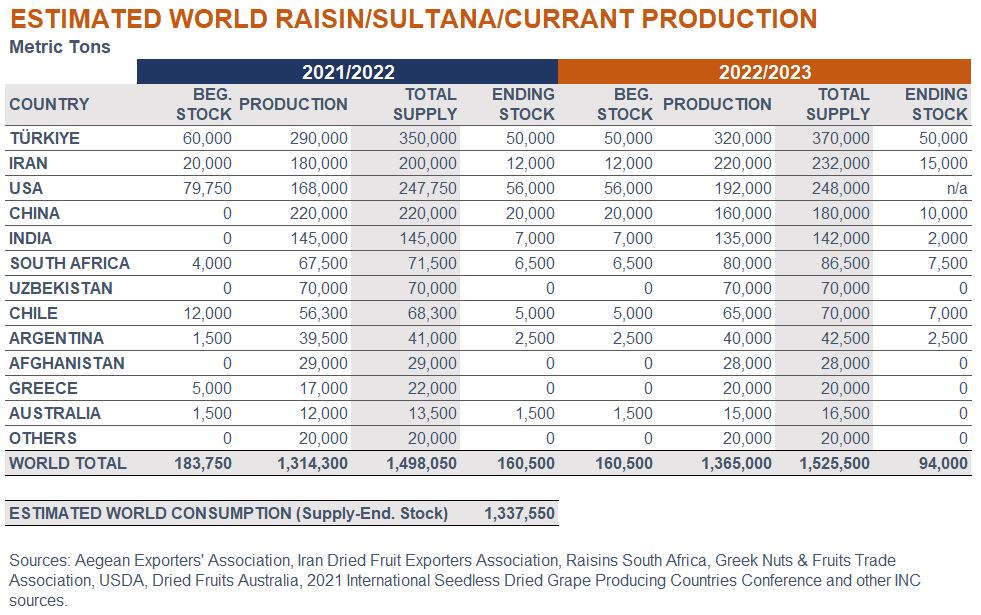
As reported by the Aegean Exporters’ Association, Sultana raisin production for 2022/23 is forecasted at 320,000 metric tons, up by 10% from 2021/22.
Exports from September 1, 2021 through August 31, 2022 reached 252,000 MT, an increase of 11% compared to the 2020/21 marketing year. New crop shipments year to date (September 1-October 1, 2022) amounted to 25,300 MT, down by 11% from the same period the prior season.
USA
The raisin growing region in California experienced favorable growing conditions during the spring and summer months. Bloom started in early May with the bunch count being on the average side. Some raisin growers were affected by the rain event that occurred in mid-September, but overall, the quality is expected to be good.
September and October are busy months for the California raisin industry with harvest and with fall baking, and holiday seasons just around the corner. Congestion at the ports is an ongoing issue with many export orders arriving at destinations later than scheduled.
According to the U.S. Census Bureau Trade Data, exports over Q1 and Q2 2022 amounted to 41,300 MT, 10% down from the same period in 2021. Japan and Canada remained the main destinations, accounting for 34% and 12% of the total share, respectively. Exports to China added up to 5,300 MT, 26% up from 2021. Imports, on the other hand, increased 54%, reaching 12,000 MT. The main origins were South Africa, with 41% of the share, Chile (30%) and Argentina (11%).
China
According to industry sources from the Xin Jiang raisins market, the 2022 production was anticipated to be normal. However, after harvesting, the initial expectations were not met and less quantity was produced due to smaller sizes and lighter weight of the raisins.
At the same time, pricing last year dropped to less than $1.5/kg, the same level of 20 years ago, therefore many growers have switched to other products or tried to sell a higher share of the crop as table grapes (about 30%), leaving less quantity available for raisin production. The quality of green raisins was also poor. Due to this shortage in quantity, at the time of this report, prices had increased by 3-5% and were expected to be kept at this level, boosting growers’ confidence.
All in all, this year’s production was revised down to 160,000 MT, while the carry-in inventory was reviewed up to 20,000 MT. Carry-out stock is expected to be lower and it is estimated at around 10,000 MT.
As per the Chinese Customs Database, 2022 imports (January-August) added up to 14,245 MT, being Uzbekistan and Chile the top origins, with 54% and 19% of the share respectively. Chile, USA, Türkiye, Australia, Greece and South Africa accounted for the remaining 27%. Exports for the same period amounted to 10,000 MT, with the UAE accounting for 25% of the share, Japan 13% and Mongolia 11%.
South Africa
According to Raisins South Africa, the industry was hampered by above-average rainfall that significantly reduced the 2021/22 crop size, by 20%. Exports have been negatively impacted by the global shipping issues. From the production standpoint, there is concern about the current inflationary pressure, with energy, labor, fertilizer and other inputs costs increasing by double digit numbers.
By the time of writing this report, the current crop was progressing well. As the producing regions entered spring, some cold weather was experienced in mid-September, but no frost damage was reported. A first official crop estimate will be announced on November 30, 2022 for 2022/23.
Prunes Global Statistical Review

As reported by the California Prune Board, this year’s growing season, farmers have managed to navigate the challenges of early frosts and multiple heat waves. As harvest grew near, it was apparent the weather had taken some toll on overall tonnage, albeit a good crop with above average sugars and excellent dry ratios. At the time of this writing, this year’s crop was estimated at ~62,000 MT. Supplies continue to be tight as strong demand outpaces production and the global industry finds itself in relative balance compared to a few years ago.
Dates Global Statistical Review

The global climatic conditions –mostly high temperatures– have had an impact on the 2022/23 date production. Thus, in general, overall harvests in the orchards have decreased. However, this reduction has not affected world production, which has remained practically stable, owing to the gradual entering into production of the new plantations that were carried out in the majority of the producing countries.
Exporters are preparing to meet the needs for the period of large consumption of table dates: the end of year celebrations for the Mediterranean countries of southern Europe and Ramadan for South-East Asia.